

I almost gave up on therapy. Again.
I’d tried CBT before—more than once, actually. In outpatient. In a group setting. Even with a private therapist. Each time, I went in thinking, Okay, this time I’ll do it the way I’m supposed to. I’d follow the steps, fill out the worksheets, try to say the “right” things.
And each time, nothing really changed.
So when I landed at Titan Recovery Centers in Las Vegas and saw that CBT—Cognitive Behavioral Therapy—was part of the schedule again, I felt myself shut down. Not because I didn’t care. Not because I didn’t want help. But because I had convinced myself: CBT doesn’t work for people like me.
Turns out, I was wrong. But not in the way I expected.
I Was Trying to Win Therapy
I’m the kind of person who does well in school. I follow instructions, get gold stars, check every box. So when I heard CBT was a structured, evidence-based approach to changing thought patterns, I thought, Perfect—I’ll master this like everything else.
But therapy isn’t a quiz. And CBT isn’t about scoring 100% on a worksheet. It’s about honesty, not performance.
The first few times I tried CBT, I didn’t get better—I got better at faking it. I learned the “correct” things to say:
- “This is an unhelpful thought.”
- “I need to reframe it.”
- “I’m challenging the belief that I’m a failure.”
All technically correct. But none of it landed. Because I didn’t believe a word of it. I wasn’t changing—I was just memorizing.
The Therapist Who Called My Bluff (With Kindness)
During one session at Titan, my therapist looked at one of my perfectly filled-out CBT logs and asked, gently:
“Is this how your mind really talks to you—or is this the cleaned-up version?”
That question hit harder than any confrontation ever could.
Because the truth was—I was terrified to put the real thoughts on paper. The dark ones. The ones that said, You’re too broken. You’re faking recovery. This is pointless.
I thought those thoughts would disqualify me from getting better. But naming them? That’s when healing started.
The First Real CBT Log I Ever Wrote
The next time, I wrote down what I was actually thinking:
“This is a waste of time. I’ll relapse anyway. Therapy never works. I don’t even want to do this right now.”
I expected judgment. I got validation.
My therapist nodded and said, “That’s more useful than any ‘positive thought’ you could’ve written.”
That session didn’t feel empowering. It felt messy. But for the first time, CBT didn’t feel fake. It felt real. And real is where change happens.
CBT Only Works If You Show Up As You Are
Once I stopped trying to “do CBT right,” it actually started helping.
I didn’t need to have the perfect reframe or the ideal insight. I just needed to be honest about what my brain was doing. Some days that sounded like:
- “I hate myself right now.”
- “I don’t trust that this is worth it.”
- “Everyone else gets better but me.”
And instead of being told to “think positive,” I was invited to ask questions:
- Is that always true?
- Where did that belief come from?
- What does my past say—and what does my present know?
That process didn’t change me overnight. But it gave me something I hadn’t had before: room to try again.
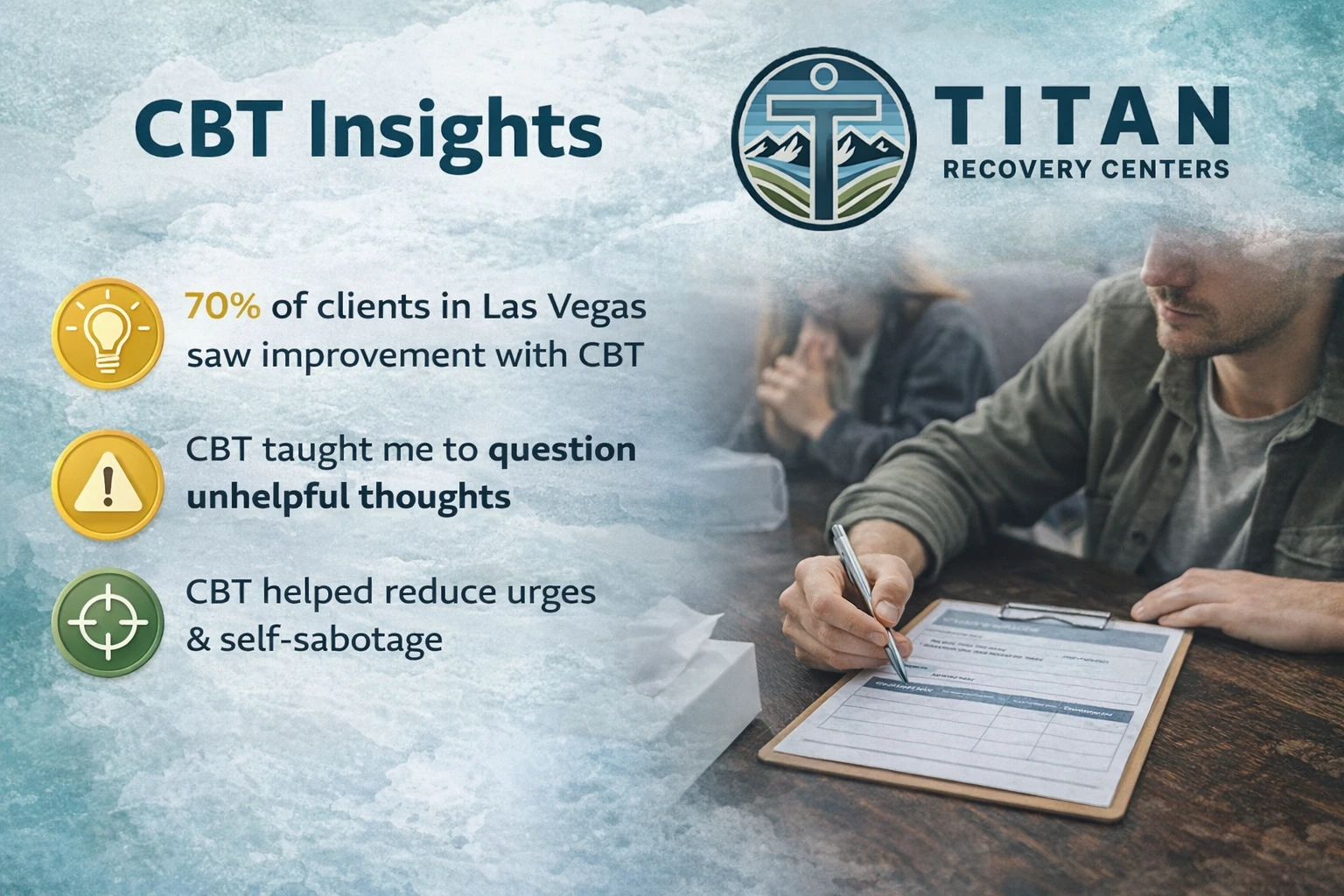
CBT Isn’t About Perfection. It’s About Permission.
Permission to be messy. To doubt. To say, I don’t know if I believe this yet—but I’m willing to look at it.
For me, that looked like catching myself mid-thought and pausing:
“There it is—that belief that I’m too much. That I always mess things up.”
Instead of trying to erase it, CBT taught me to interact with it.
- Is this thought true, or is it familiar?
- Am I reacting to now, or to something old?
- If I believed the opposite, how would I behave?
That shift—from judgment to curiosity—is what turned CBT from a tool I resented to one I rely on.
Why CBT at Titan Recovery Was Different
I’d been through therapy before. I’d been handed CBT worksheets before. But Titan Recovery Centers in Las Vegas did something different: they treated me like a whole person—not a checklist.
They never rushed me to “fix” my thinking. They didn’t reward me for saying the right thing. They met me—in my cynicism, my hopelessness, my eye-rolls—and walked with me anyway.
That kind of support made it safe enough to be honest. And once I was honest, CBT could finally work.
If you’re looking for CBT in Henderson, NV or nearby areas like Spring Valley, NV, Titan offers trauma-informed support that doesn’t expect perfection—just presence.
What Changed in My Life (That I Didn’t Expect)
CBT didn’t give me a new personality. It didn’t erase my struggles. But it gave me access to choice—in the moments I used to feel trapped by my own mind.
Here’s what’s different now:
- I can name my thoughts without obeying them.
- I can slow down when the spiral starts.
- I can sit with discomfort without letting it dictate my behavior.
- I can forgive myself for having bad days—and keep going anyway.
That’s recovery. Not some magical “fix,” but the power to stay in the room when things get hard.
FAQs About CBT (from Someone Who Genuinely Hated It at First)
What is CBT really?
CBT (Cognitive Behavioral Therapy) is a structured therapy that helps you identify, question, and shift unhelpful thought patterns. It’s not about “thinking positive”—it’s about getting honest with your brain.
What if I don’t believe the new thoughts?
That’s normal. CBT isn’t about faking belief—it’s about trying on a different perspective and seeing what shifts. Doubt is part of the process.
I’ve already done CBT before. Why try again?
Maybe you weren’t ready. Maybe the therapist wasn’t the right fit. Or maybe you were performing instead of participating (like I was). That doesn’t mean it can’t work—it means your relationship to it might need to change.
Do I have to journal or do homework?
Most therapists will encourage it—but it’s not graded. The goal is insight, not perfection. If something feels pointless or overwhelming, talk about it. CBT is adaptable.
Is CBT good for addiction recovery too?
Yes—and that’s why it’s part of Titan’s integrated treatment. CBT helps you understand the thoughts and beliefs that fuel relapse patterns, guilt spirals, and self-sabotage.
What if I think it’s all BS?
Perfect. Start there. Bring that into the room. A good therapist won’t try to convince you—they’ll meet you where you are and get curious with you.
You’re Not Failing Therapy—You Might Just Be Faking It (Like I Was)
I spent so long trying to be good at therapy that I missed the point. Therapy isn’t about being good. It’s about being real. And CBT only works when you stop trying to impress it.
If you’re in Las Vegas—or looking for CBT in North Las Vegas—and you’ve said to yourself, “I already tried therapy and it didn’t work,” I hope you’ll consider this:
Maybe it’s not about trying harder.
Maybe it’s about trying honester.
Call (888) 976-8457 to learn more about our Cognitive Behavioral Therapy in Las Vegas, Nevada. You don’t have to fix everything today. You just have to show up as you are. That’s where it begins.
