

“I don’t need CBT. I just need to be more disciplined.”
When high-functioning clients sit across from me for the first time, that’s usually the tone. Controlled. Polished. Slightly defensive.
They’re not in crisis. They’re not missing work. They’re not falling apart publicly.
But they’re exhausted.
If you’re considering cognitive behavioral therapy (CBT), and part of you still thinks, “This might be overkill,” this blog is for you.
Because the lie isn’t loud. It’s subtle.
And it sounds responsible.
The Lie: “If I’m Still High-Functioning, I’m Fine.”
You’re productive. You pay your bills. You show up for your family. You meet deadlines.
From the outside, you’re solid.
Inside? It’s a different story.
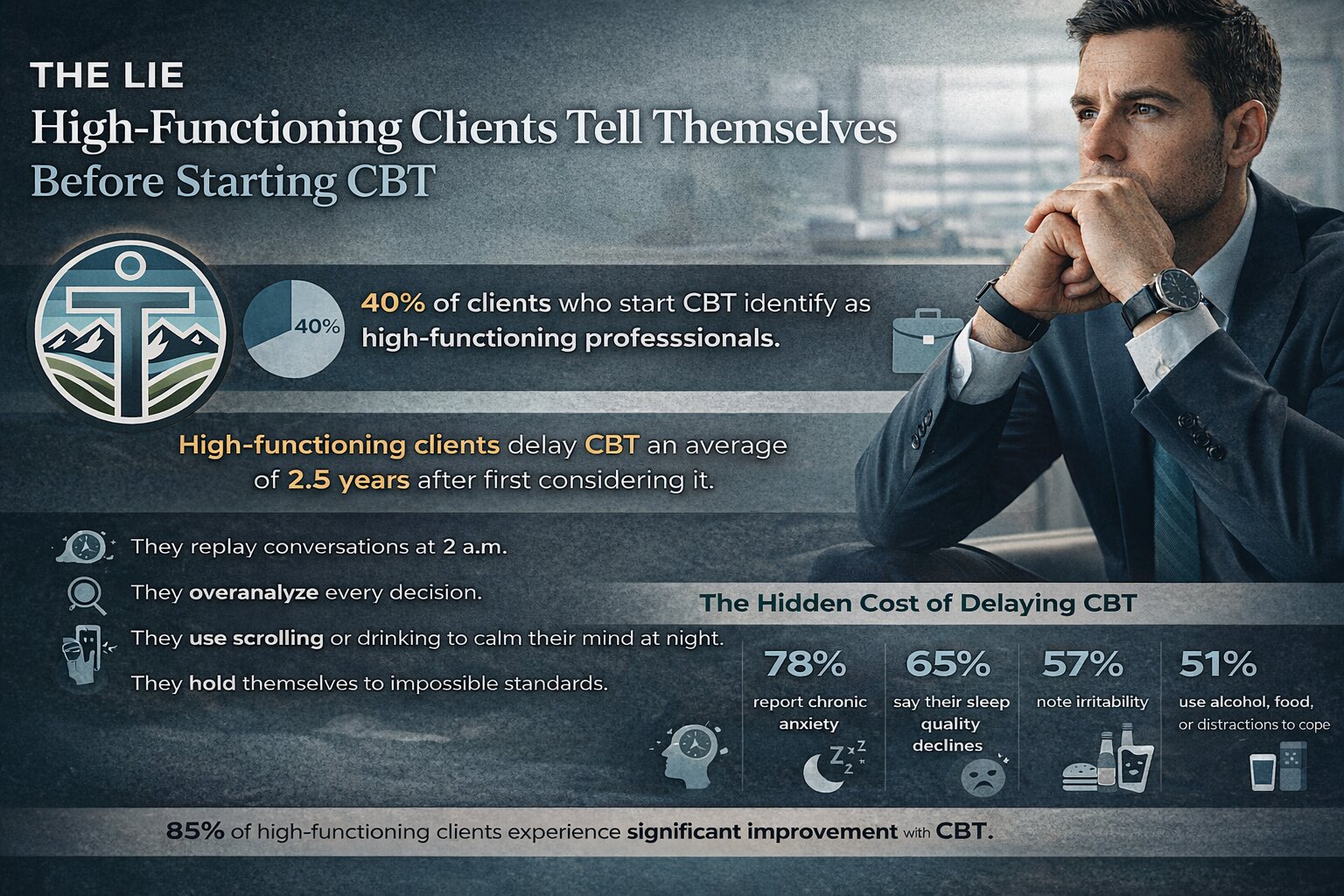
You replay conversations at 2 a.m.
You overanalyze every decision.
You need a drink, scrolling, or distraction just to shut your brain off at night.
You hold yourself to standards you would never expect from anyone else.
High-functioning people don’t implode. They erode.
CBT isn’t for when you can’t function. It’s for when functioning is costing you too much.
High-Functioning Doesn’t Mean Emotionally Regulated
This is where people get tripped up.
You can manage logistics and still struggle with your thoughts.
You can excel at work and still be hijacked by anxiety.
You can look composed while internally narrating your own inadequacy all day long.
One of the core principles of cbt is this: your thoughts shape your emotional and behavioral responses.
High-functioning clients often have extremely efficient thinking patterns—but those patterns are rigid, harsh, and fear-driven.
Examples I hear constantly:
- “If I’m not the best, I’m failing.”
- “If I don’t anticipate every problem, I’m irresponsible.”
- “If I let people see I’m struggling, they’ll lose respect.”
- “Rest equals laziness.”
These thoughts don’t feel distorted. They feel like standards.
But they’re exhausting.
The Hidden Cost of White-Knuckling Life
Many high-achieving clients are running on adrenaline and self-criticism.
It works—until it doesn’t.
At some point, symptoms start creeping in:
- Chronic anxiety
- Irritability at home
- Emotional numbness
- Sleep problems
- Increased reliance on alcohol, food, or other coping behaviors
- A sense that you’re never actually “done”
You tell yourself this is just adulthood.
But adulthood isn’t supposed to feel like you’re bracing for impact every day.
CBT helps you examine the engine behind that constant bracing.
The Fear Behind Delaying CBT
Let me say something clearly.
You’re not avoiding therapy because you’re arrogant.
You’re avoiding it because you’re scared of what slowing down might uncover.
High-functioning individuals often worry that:
- Therapy will make them less driven.
- They’ll lose their competitive edge.
- They’ll have to dismantle the identity that made them successful.
- They’ll be told they’re “too much” or “too intense.”
In reality, cbt is structured and practical. It doesn’t ask you to abandon your ambition. It helps you remove the unnecessary suffering wrapped around it.
You don’t lose your edge.
You lose the internal attack.
What Actually Happens When High-Functioning Clients Start CBT
Here’s what I see again and again.
Within weeks, something shifts.
Not dramatically. Quietly.
They start catching their thoughts in real time.
Instead of spiraling for hours after a minor mistake, they identify the distortion:
- Catastrophizing.
- Mind-reading.
- All-or-nothing thinking.
- Personalization.
CBT gives language to patterns that once felt like personality traits.
And once you can name a pattern, you can challenge it.
One client—an executive—told me, “I thought anxiety was the reason I succeeded. Turns out, it was just the reason I was miserable.”
Another said, “I didn’t realize how loud my inner critic was until it got quieter.”
That quiet is powerful.
The Myth: “CBT Is Only for Severe Mental Illness”
This is a big one.
Many high-functioning people believe therapy is for people who “can’t cope.”
But cbt is often most effective for individuals who can reflect, apply tools, and practice skills between sessions.
It’s collaborative. Structured. Skill-based.
You don’t just talk about your week.
You examine thought patterns.
You test assumptions.
You run behavioral experiments.
You practice reframing.
It’s mental training.
If you can train your body or your career, why not your thinking?
Signs You Might Benefit from CBT (Even If You’re High-Functioning)
You might be a strong candidate for cbt if:
- You’re successful but constantly anxious.
- You replay conversations long after they’re over.
- You struggle to relax without guilt.
- You hold yourself to punishing standards.
- You fear being exposed as “not enough.”
- You rely on overworking or numbing to manage emotions.
- You feel emotionally flat despite outward success.
You don’t need a breakdown to justify support.
You just need honesty.
The Real Work of CBT for High-Functioning Clients
CBT isn’t about positive thinking.
It’s about accurate thinking.
That means learning to:
- Identify cognitive distortions in the moment.
- Separate facts from interpretations.
- Reduce black-and-white thinking.
- Replace self-criticism with accountability.
- Tolerate discomfort without escaping it.
- Build flexible thinking instead of rigid rules.
For high-functioning individuals, the breakthrough often isn’t “I’m broken.”
It’s “I’ve been running on a script that no longer serves me.”
And scripts can be rewritten.
What You Gain (That You Didn’t Know You Were Missing)
When CBT clicks, here’s what tends to change:
You make decisions without spiraling.
You rest without shame.
You stop assuming the worst about yourself.
You respond instead of react.
You feel present instead of perpetually bracing.
One of my clients described it like this:
“I didn’t realize how tight I was holding everything. CBT felt like unclenching.”
That’s the word.
Unclenching.
Not collapsing. Not giving up.
Just releasing unnecessary tension.
Frequently Asked Questions About CBT for High-Functioning Adults
Is CBT too basic for someone who is self-aware?
No. Self-awareness and skill application are different things. Many high-functioning individuals understand their patterns intellectually. CBT helps you interrupt and restructure those patterns in real time. Insight is helpful—but skills create change.
Will CBT make me less ambitious?
No. It may change why you push yourself—but not your capability. CBT often reduces fear-based motivation while preserving healthy drive. You can still aim high. You just won’t need shame to fuel it.
How long does CBT take to work?
Many clients notice measurable shifts within 6–12 sessions. CBT is structured and goal-oriented. It’s not open-ended processing without direction. Progress is trackable.
What if I’m not in crisis? Is it still worth it?
Yes. You don’t need to be drowning to learn how to swim better. Many high-functioning clients seek CBT because they’re tired of surviving on stress. You’re allowed to want more than “managing.”
How is CBT different from just talking to a friend?
Friends offer validation. That matters. CBT offers structured intervention. A trained clinician helps you identify distortions, test assumptions, and build alternative thought patterns. It’s intentional and evidence-based—not just supportive conversation.
What if I’ve tried therapy before and it didn’t help?
That’s valid. Not all therapy is structured. Not all therapists use CBT formally. If you previously experienced open-ended talk therapy without clear tools, CBT may feel very different. It’s active. Collaborative. Practical.
The Hard Truth (And the Hope)
Here’s what I’ll say as a clinician.
The clients who wait the longest are often the ones who needed support the most—but were strong enough to avoid it.
High-functioning can become a mask.
And masks are heavy.
You don’t have to hit rock bottom to deserve relief. You don’t have to implode publicly to justify private support.
If you recognize yourself in this—if you’re performing strength while quietly unraveling—it might be time to stop white-knuckling it.
Structured, evidence-based care exists specifically for people who are used to handling everything on their own.
You can keep succeeding.
You just don’t have to keep suffering.
If you’re ready to explore focused, skill-based support, our team at Titan Recovery Centers offers structured, individualized cognitive behavioral therapy (CBT) designed for high-functioning adults who are tired of carrying everything alone.
Call (888) 976-8457 or visit to learn more about our cbt services in Spring Valley, NV.
