

When your child is in a behavioral health crisis, everything feels urgent. Sleep disappears. Conversations feel fragile. You may be watching someone you love become unrecognizable—and wondering how it got here.
In moments like this, families don’t need complicated theory. They need something grounded. That’s why cbt is often the first line of defense in behavioral health treatment. At Titan Recovery Centers, we use it as a foundational tool because it brings structure to chaos and skills to overwhelming emotion. You can learn more about our full approach to cognitive behavioral therapy here, but below we’ll explain what it means in real, practical terms.
What Is CBT — and Why Is It So Widely Used?
CBT stands for cognitive behavioral therapy.
At its core, it’s based on one powerful principle: our thoughts influence our emotions, and our emotions influence our behavior.
When someone is in crisis, their thoughts often become distorted. Not because they’re weak. Not because they’re dramatic. But because their nervous system is overwhelmed.
Thoughts like:
- “I’m a failure.”
- “No one understands me.”
- “Nothing is ever going to change.”
- “I can’t handle this.”
CBT doesn’t dismiss these thoughts. It helps your child slow them down, examine them, and test whether they’re fully accurate. It teaches them to notice patterns like all-or-nothing thinking, catastrophizing, and emotional reasoning.
And that awareness? It creates breathing room.
In crisis, breathing room can be life-changing.
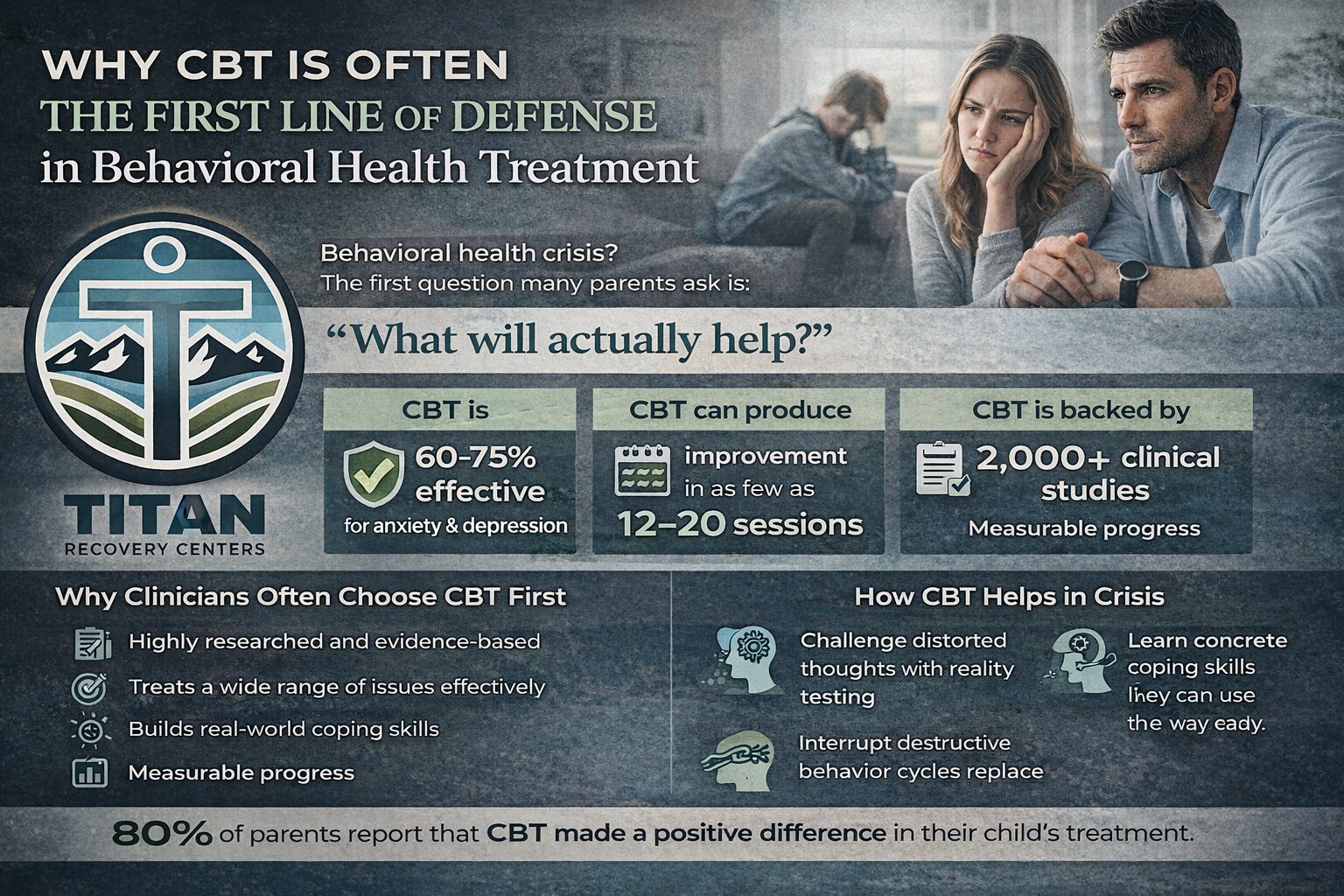
Why CBT Is Often the First Line of Defense in Behavioral Health Care
When a young adult is experiencing severe anxiety, depression, impulsive behaviors, emotional dysregulation, or even early psychosis symptoms, clinicians need something reliable and structured.
CBT is often used first because:
- It is extensively researched and evidence-based.
- It applies to a wide range of diagnoses.
- It focuses on skill-building.
- It produces measurable progress.
- It gives clients tools they can use immediately.
In other words, it’s practical.
Think of it this way: if your child had a broken arm, we would stabilize it first. We wouldn’t start with deep philosophical conversations about how it broke. We’d secure it, reduce pain, and begin strengthening.
CBT stabilizes the mind in a similar way.
How CBT Helps During Emotional Freefall
Crisis often involves spirals.
One negative thought leads to intense emotion. That emotion leads to impulsive behavior. That behavior creates consequences. The consequences reinforce the original negative belief.
It becomes a loop.
CBT helps interrupt that loop in three key ways:
1. Identifying Distorted Thinking
Your child learns to spot patterns like:
- Black-and-white thinking (“If I’m not perfect, I’m worthless.”)
- Catastrophizing (“This mistake ruined my entire future.”)
- Mind reading (“Everyone thinks I’m a disappointment.”)
Naming the distortion weakens its power.
2. Challenging Automatic Assumptions
CBT encourages evidence-based questioning:
- What facts support this thought?
- What facts contradict it?
- Is there another possible explanation?
This isn’t forced positivity. It’s reality testing.
3. Practicing New Behavioral Responses
Instead of withdrawing, they may practice engaging.
Instead of lashing out, they may practice pausing.
Instead of shutting down, they may practice structured coping skills.
Small behavioral changes often shift emotional intensity faster than parents expect.
CBT Builds Skills — Not Dependency
Many parents quietly ask: Are we signing up for something that never ends?
CBT is intentionally skill-based. The goal isn’t endless therapy. It’s equipping your child with tools they can carry into daily life.
Skills often include:
- Emotional regulation techniques
- Behavioral activation (especially for depression)
- Exposure strategies for anxiety
- Thought records and journaling exercises
- Structured problem-solving methods
- Distress tolerance strategies
Your child learns how to become their own internal coach.
The therapy room becomes a practice field—not a crutch.
Why Structure Matters So Much in Crisis
When someone is in behavioral health crisis, their world often feels chaotic. Sleep may be disrupted. Appetite may shift. Relationships strain. School or work performance drops.
CBT introduces predictability.
Sessions follow a format. Goals are clearly defined. Progress is measurable. Homework reinforces skills between sessions.
Structure reduces uncertainty.
And when panic is high, predictability feels safe.
CBT and Medication: Are They Used Together?
Sometimes, yes.
CBT is often combined with psychiatric medication when symptoms are severe. Medication can stabilize mood or reduce intensity, while CBT teaches long-term coping skills.
It’s not either-or. It’s about what’s clinically appropriate.
We help families understand options clearly. No pressure. No scare tactics. Just honest guidance.
What If My Child Doesn’t Want Therapy?
This is one of the hardest realities for parents.
Young adults in crisis often feel defensive, embarrassed, or mistrustful. CBT can be helpful in these situations because it doesn’t immediately demand deep emotional disclosure.
It begins with practical tools:
- How to reduce panic attacks
- How to sleep more consistently
- How to manage intrusive thoughts
- How to respond to anger without exploding
When they see improvement, trust builds.
Progress opens the door.
You Didn’t Cause This — and You’re Not Helpless
We see it in parents’ eyes all the time: guilt.
You replay conversations. You question decisions. You wonder what you missed.
CBT doesn’t center blame. It centers capacity.
It focuses on what can change now.
You cannot control every thought your child has. But you can choose skilled support. You can create an environment where growth is possible. You can remain steady while professionals guide treatment.
And steadiness matters more than perfection.
What Makes CBT Different From “Just Talking”?
Many parents worry that therapy is simply venting.
CBT is structured and goal-oriented. Sessions typically include:
- A brief check-in
- Review of previous skill practice
- Focused work on a specific issue
- Planning for the week ahead
It’s collaborative. Measurable. Practical.
Talking is part of it. But skill-building is the backbone.
Frequently Asked Questions About CBT
How long does CBT usually take?
CBT is often short- to medium-term. Many clients engage in 12–20 sessions, though this varies based on symptom severity and diagnosis. Some individuals benefit from longer care, especially if trauma or chronic conditions are involved.
The focus is progress, not an arbitrary timeline.
Is CBT effective for severe depression?
Yes. CBT is one of the most researched treatments for depression. It helps individuals challenge hopeless thinking, increase activity levels, and re-engage with meaningful routines.
In more severe cases, it may be paired with medication or higher levels of care.
Can CBT help with anxiety and panic attacks?
Absolutely. CBT is widely used for anxiety disorders, including panic disorder, generalized anxiety, social anxiety, and phobias.
It teaches clients how to identify fear-based thoughts and gradually face triggers in controlled, supportive ways.
What if my child has multiple diagnoses?
CBT is adaptable. It can address overlapping symptoms across depression, anxiety, trauma, and mood instability.
Treatment plans are individualized. We don’t use one-size-fits-all care.
Is CBT confrontational?
No. It is collaborative.
Therapists guide questioning gently. The goal is not to argue with your child’s feelings—but to help them examine patterns safely.
Respect is foundational.
How soon will we see results?
Some families notice small changes within a few weeks—improved sleep, fewer emotional outbursts, better communication.
Larger shifts take time.
Healing is rarely dramatic. It’s often quiet and steady.
What is my role as a parent during CBT?
Your role is support and stability.
Depending on the situation, family sessions may be included. We may provide education on communication tools or boundaries. But you are not expected to become your child’s therapist.
You’re allowed to be the parent.
When your child is in crisis, you need something solid. CBT is often that starting point—a structured, evidence-based approach that helps stabilize thoughts, regulate emotions, and reduce harmful behaviors.
You don’t have to navigate this alone.
Call (888) 976-8457 or visit to learn more about our cbt services in Las Vegas, NV.
