

You’re not afraid of healing.
You’re afraid of becoming someone unrecognizable.
When people first hear about cbt, they sometimes imagine a softened version of themselves. Less intense. Less creative. Less magnetic.
If substances have felt like the spark plug for your ideas, your humor, your confidence, or your depth—of course you’re scared.
Let’s say the quiet part out loud:
What if sobriety makes me boring?
What if therapy flattens me out?
What if the chaos is the price of being exceptional?
I’ve heard all of it. And I take it seriously.
CBT Isn’t Here to Erase You
As a clinician, I don’t see your intensity as a problem to fix.
I see it as something powerful that hasn’t always been protected well.
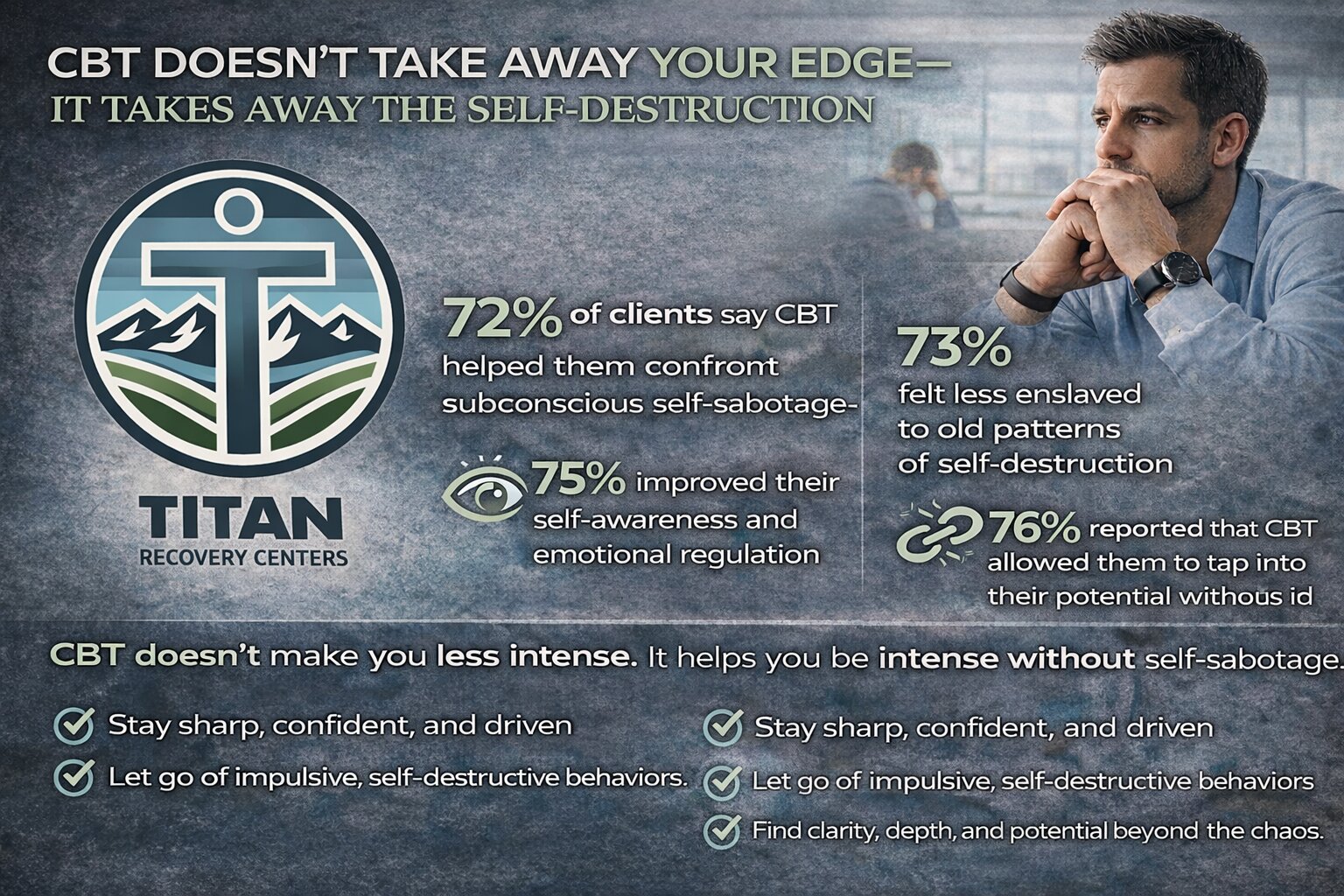
Cognitive behavioral therapy (CBT) doesn’t aim to rewrite your personality. It doesn’t try to turn artists into accountants or extroverts into monks. It focuses on patterns—especially the ones that quietly sabotage you.
The late-night spiral.
The belief that you need something external to access your best self.
The all-or-nothing thinking that swings you from genius to disaster.
You get to keep your fire.
We just help you stop using gasoline to manage it.
The Myth: CBT Will Make Me Flat
Let’s address the fear directly.
Some people imagine cbt as overly logical. Mechanical. Cold. Like someone is going to sit across from you and correct every emotional impulse.
That’s not how this works.
CBT doesn’t say, “Don’t feel that.”
It asks, “What are you telling yourself right now—and is it true?”
It’s not about dampening emotion.
It’s about separating emotion from distortion.
You can be intense without being destructive.
You can be sensitive without being swallowed whole by your own thoughts.
Flatness isn’t the goal. Stability is.
And stability doesn’t eliminate your edge. It makes it sustainable.
What CBT Actually Targets (And What It Doesn’t)
Here’s what CBT works with:
- Automatic thoughts that trigger shame or self-sabotage
- Core beliefs like “I’m only interesting when I’m high”
- Catastrophic thinking that fuels impulsive decisions
- Black-and-white narratives about success and failure
Here’s what it does not target:
- Your creativity
- Your humor
- Your depth
- Your emotional range
- Your charisma
CBT isn’t interested in sanding down your personality.
It’s interested in challenging the thoughts that quietly hurt you.
For example:
“I need this to perform.”
“If I stop, I’ll lose momentum.”
“I’m only lovable when I’m on.”
In therapy, we don’t mock these thoughts. We examine them. We test them. We get curious.
And often, what we find is that the substance wasn’t the source of your magic.
It was your mind.
A Pattern I See Again and Again
I’ve worked with people who were brilliant—writers, founders, creatives, high-performing professionals. Many of them told me in the first session:
“If I quit, I’ll lose the only interesting thing about me.”
They didn’t.
What they lost was:
- The 3 a.m. anxiety spiral
- The self-hatred after social events
- The creative bursts followed by emotional crashes
- The relationships strained by unpredictability
One client told me months into CBT:
“I thought the chaos was my personality. Turns out it was just untreated thinking patterns.”
That sentence stayed with me.
Chaos can masquerade as identity.
But they’re not the same thing.
CBT Expands Your Range
Substances can feel like a shortcut.
Louder laughs.
Bigger risks.
Sharper wit.
More vulnerability.
But shortcuts come with hidden costs.
The crash.
The shame.
The dependency.
The quiet fear of losing control.
With cbt, you learn to access:
- Confidence without chemical support
- Creativity without self-destruction
- Emotional depth without drowning in it
- Vulnerability without regret
It’s like learning to drive a powerful car without slamming the accelerator every time you feel something.
You still have the engine.
Now you have brakes and steering.
That’s not boring. That’s mastery.
The Real Fear: “Who Am I Without This?”
This is the part we don’t rush.
For many people, substances are woven into identity:
The funny one at parties.
The deep one who always has a drink in hand.
The risk-taker.
The emotionally open one—after a few.
Letting go can feel like stepping into a social vacuum.
In CBT, we slow that down. We explore it. We ask:
Who were you before this became necessary?
What parts of you show up even when you’re sober?
What beliefs are you carrying that no longer serve you?
Often, people discover something unexpected:
Their edge wasn’t coming from the substance.
It was coming from permission.
Permission to feel.
Permission to speak.
Permission to take up space.
CBT helps you build that permission internally—so it doesn’t disappear when the substance does.
If you’re curious about how this process works in practice, you can explore more about our approach to cognitive behavioral therapy and how we tailor it to individuals who value identity and creativity.
What Happens to Creativity in CBT?
This is a common and important question.
Creativity is often linked to heightened emotion. And heightened emotion can sometimes feel easier to access under the influence.
But here’s what I’ve seen:
When the self-criticism decreases, creativity expands.
When shame softens, risk-taking becomes cleaner.
When your sleep improves, your thinking sharpens.
CBT reduces the mental noise.
And mental noise is often what blocks creativity—not fuels it.
You don’t lose your depth.
You lose the static.
The Subtle Gift of Stability
Stability doesn’t mean dull.
It means:
You can feel something strongly without imploding.
You can succeed without sabotaging yourself afterward.
You can rest without guilt.
Many people equate intensity with aliveness. But real aliveness includes steadiness.
You deserve to feel powerful without paying for it later.
And that’s what CBT supports: power without punishment.
FAQ About CBT and Identity
Will CBT change my personality?
No. CBT focuses on thought patterns and behaviors—not your core identity. The goal is to help you respond to thoughts more flexibly, not to rewrite who you are. Most people report feeling more like themselves over time, not less.
Does CBT make people less emotional?
CBT doesn’t reduce your capacity to feel. It helps you regulate how you respond to emotion. You’ll still feel deeply—but with more choice and less impulsivity.
What if I rely on substances to be social or creative?
That’s common—and understandable. In therapy, we explore what the substance provides (confidence, looseness, relief) and work on building those qualities internally. The goal isn’t to strip you of connection. It’s to make connection sustainable.
Is CBT too structured for creative people?
CBT does have structure—but structure can create safety. Within that safety, creativity often grows. Many creative individuals appreciate having tools that ground them without suppressing their depth.
How long does CBT take to work?
Some people notice shifts within a few sessions—especially in how they relate to their thoughts. Deeper belief changes take longer. Therapy isn’t about rushing transformation. It’s about building lasting patterns.
What if I’m afraid I’ll miss who I used to be?
That fear deserves respect. In therapy, we don’t dismiss nostalgia or attachment. We examine it carefully. Often, what people miss isn’t the substance—it’s the freedom they associate with it. CBT helps you reclaim that freedom in healthier ways.
You Don’t Lose Your Edge. You Lose the Self-Destruction.
I won’t promise that growth feels comfortable.
Letting go of old coping strategies—especially ones tied to identity—can feel vulnerable. There may be moments where you question yourself.
But here’s what I’ve consistently seen:
People don’t become less interesting.
They become less exhausted.
Less ashamed.
Less afraid of themselves.
Your intensity was never the enemy.
Your brilliance was never the problem.
CBT doesn’t dim the light.
It removes the smoke.
If this conversation feels personal—if you’ve been quietly wondering whether healing means disappearing—you don’t have to navigate that alone.
Call (888) 976-8457 or visit to learn more about our CBT services in Las Vegas, NV.
