

I used to say cbt didn’t work.
I said it calmly. Confidently. Like someone who had already tried everything.
What I didn’t say was this: it worked enough to make me uncomfortable — and I bailed.
If you’ve been through therapy before and walked away thinking, “That didn’t do anything,” I’m not here to argue with you. I’m here to tell you what I missed the first time — and why going back to cbt at Titan Recovery Centers felt completely different.
Not because the therapy changed.
Because I finally stopped pretending.
I Was Doing CBT — But I Wasn’t Letting It Touch the Real Stuff
On paper, I was a “good” client.
I filled out the worksheets.
I tracked my moods.
I could explain cognitive distortions like I was studying for a quiz.
But I was carefully editing myself.
If a thought felt too embarrassing, I’d soften it.
If a pattern made me look insecure, I’d reframe it.
If I was jealous, reactive, controlling, or scared — I’d sanitize it before I brought it into session.
CBT isn’t magic. It can only work with what you give it.
And I was handing it the safe version of me.
CBT Is a Mirror — Not a Motivational Speech
Here’s what frustrated me the first time: CBT didn’t hype me up. It didn’t give me a dramatic emotional breakthrough.
It gave me a structure.
Cognitive behavioral therapy is simple in theory:
- Thoughts influence feelings.
- Feelings influence behaviors.
- Behaviors reinforce thoughts.
It sounds almost basic.
But when you start mapping your own patterns, it’s like finding the wiring diagram behind your personality. You see loops you didn’t know were there.
For me, it looked like this:
Thought: “They’re pulling away.”
Feeling: Anxiety.
Behavior: I get cold or defensive.
Result: They actually pull away.
New Thought: “See? I knew it.”
That wasn’t fate. It was a self-fulfilling script.
CBT didn’t accuse me. It just showed me the loop.
And once you see the loop, you can’t blame the world the same way anymore.
The Hard Truth: I Wanted Validation More Than Change
This is the part no one likes to admit.
I wanted someone to say, “You’re right. It’s not you.”
And sometimes that’s true. Sometimes people really do treat you poorly. Sometimes situations are genuinely unfair.
But in my case?
There were patterns I was contributing to.
CBT isn’t about blaming you. It’s about agency.
It asks:
- What part of this cycle belongs to you?
- What belief is driving your reaction?
- What happens if you interrupt it?
That felt threatening at first. Because if I had influence, then I also had responsibility.
And responsibility is heavier than victimhood.
CBT Forced Me to Question My “Facts”
Before CBT, my thoughts felt absolute.
“If I don’t get this right, I’ll fail.”
“They didn’t text back. They must be upset.”
“I always mess things up.”
There was no gap between thought and truth.
CBT introduced space.
Is that a fact — or a prediction?
Is that mind reading — or evidence?
What would I tell a friend who said this?
At first, it felt almost robotic to challenge my own thinking. But over time, something shifted.
I started noticing my thoughts instead of being swallowed by them.
That’s a massive difference.
It Wasn’t That CBT Didn’t Work — It Worked Slowly
I expected a breakthrough moment.
What I got instead was repetition.
CBT is behavioral. It’s about practice. You don’t just understand a new thought pattern — you rehearse it until it becomes natural.
At first, replacing a distorted thought feels fake.
If your brain says, “I’m terrible at this,” and you counter with, “I’m learning,” it feels forced. Like you’re lying to yourself.
But the original thought wasn’t neutral either. It was trained.
CBT is retraining.
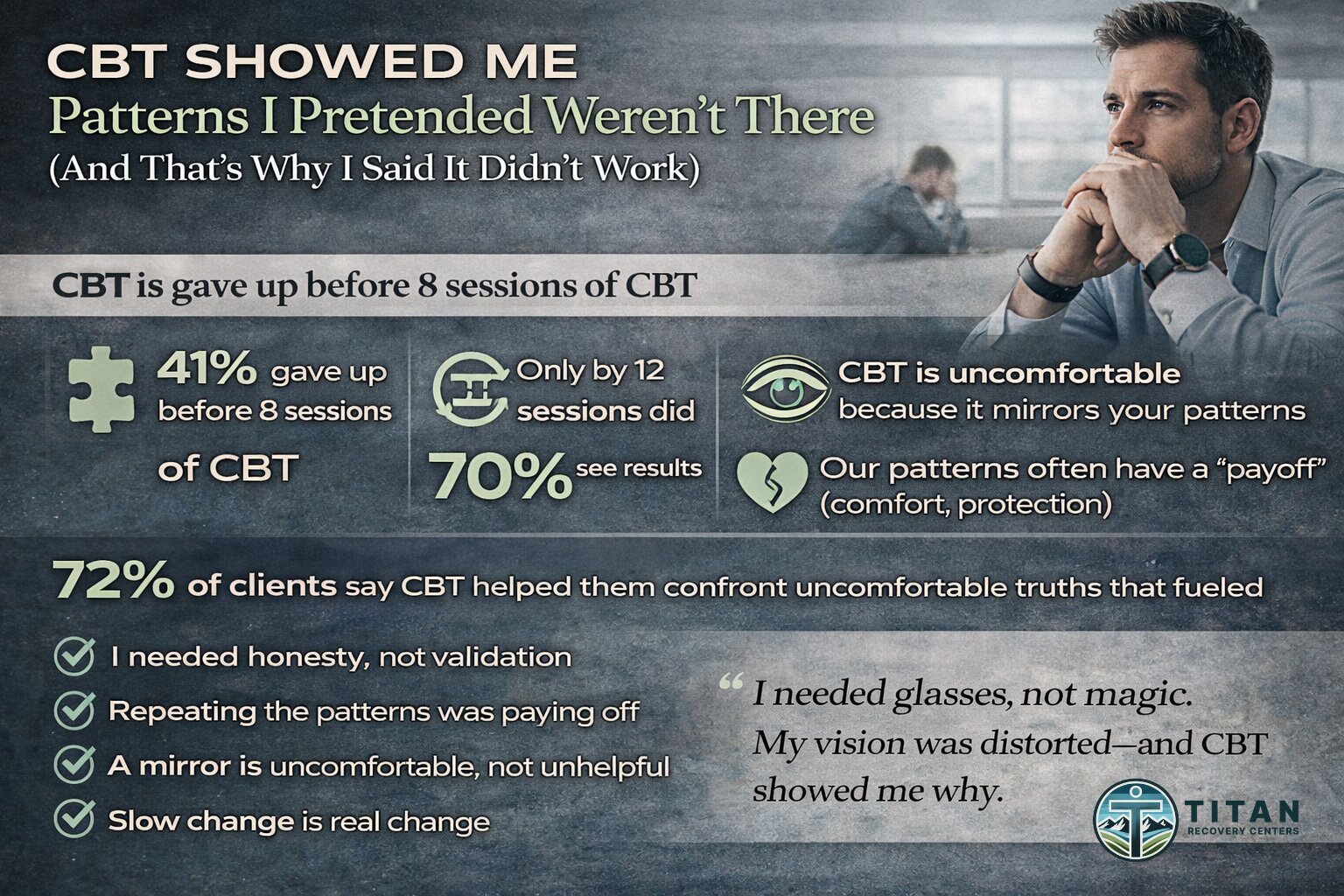
You don’t undo years of automatic thinking in six sessions. And I think that’s where a lot of us quit. We want relief to feel dramatic.
Sometimes it feels subtle.
Then one day, you notice you didn’t spiral over something that used to wreck you.
That’s the shift.
I Had to Admit My Patterns Had a Payoff
This one hurt.
Some of my “negative” patterns were protecting me.
Assuming the worst? It kept me from being blindsided.
Avoiding conflict? It kept me from rejection.
Shutting down emotionally? It kept me from vulnerability.
There was a payoff.
CBT doesn’t shame coping strategies. It just asks if they’re still serving you.
And that question can be uncomfortable.
Because if they’re not serving you anymore, you have to risk something new.
Why It Felt Different the Second Time
When I came back to therapy, I wasn’t hopeful. I was tired.
Tired of the same arguments.
Tired of the same anxious spirals.
Tired of saying, “This is just how I am.”
This time, I didn’t perform.
I brought the embarrassing thoughts. The irrational ones. The ugly jealousy. The catastrophizing.
And instead of being judged, I was guided through them.
That’s what surprised me most.
CBT isn’t cold. It’s structured. And structure can feel safer than vague reassurance.
At Titan Recovery Centers, the focus wasn’t just “think positive.” It was:
Let’s examine this. Slowly. Carefully. Together.
That made the difference.
Signs You Might Have Dismissed CBT Too Early
You might recognize yourself here if:
- You understood the concepts but didn’t apply them outside session.
- You avoided bringing up thoughts that felt shameful.
- You expected a breakthrough instead of gradual change.
- You stopped when it felt repetitive or mechanical.
- You wanted validation more than restructuring.
That’s not failure. It’s human resistance.
But resistance doesn’t mean therapy can’t work. Sometimes it means you were closer to the nerve than you realized.
What CBT Actually Gave Me
Not a new personality.
Not fake positivity.
It gave me:
- A pause between thought and reaction.
- Language for patterns I couldn’t name.
- Evidence that my brain isn’t always telling the truth.
- A sense of control that didn’t rely on other people changing first.
That’s not flashy. But it’s powerful.
It’s like finally getting glasses after years of squinting. The world didn’t change. Your vision did.
FAQ About CBT (Especially If You’re Skeptical)
What is CBT, really?
Cognitive behavioral therapy (cbt) is a structured form of therapy that focuses on identifying and changing unhelpful thought patterns and behaviors. It’s practical and skill-based. You don’t just talk — you practice.
It connects your thoughts, emotions, and actions so you can interrupt cycles that keep you stuck.
Why does CBT feel “too simple” sometimes?
Because it is simple. The framework is straightforward. The challenge is applying it consistently. Repetition can feel boring — but repetition is what rewires patterns. Simple doesn’t mean shallow. It means usable.
What if CBT didn’t work for me before?
That doesn’t mean it won’t work now. Sometimes timing matters. Sometimes the therapist fit matters. Sometimes your readiness to examine certain beliefs matters.
If you tried it once and it felt flat, that doesn’t disqualify you from benefiting later.
Is CBT just “positive thinking”?
No. CBT doesn’t tell you to ignore reality or force optimism. It helps you test whether your thoughts are accurate, exaggerated, or incomplete.
It’s about balanced thinking, not blind positivity.
How long does CBT take to work?
Some people notice small shifts within weeks. Deeper patterns can take months. It depends on how entrenched the beliefs are and how consistently you practice the tools. CBT is active. The more you use it, the more it works.
Is CBT right for anxiety and depression?
CBT is widely used for anxiety, depression, and other mental health challenges because it directly addresses distorted thinking patterns that fuel emotional distress.
It’s especially helpful if you feel stuck in repetitive negative loops.
If you’re reading this thinking, “I already tried. Why would this be different?” — that’s fair.
Skepticism usually comes from disappointment.
But sometimes what didn’t work wasn’t the therapy. It was the wall we kept up while sitting in it.
If you’re willing to look at your patterns honestly — not perfectly, just honestly — CBT might land differently than it did before.
Call (888) 976-8457 or visit to learn more about our CBT services in Las Vegas, NV.
