

You’re good at what you do. Very good. People rely on you. You’ve built things others admire. You’ve met deadlines, kept schedules, held families together, answered emails at midnight, and somehow made it all look effortless.
And yet…
There’s this quiet tension that never fully goes away.
You find yourself needing a drink to relax after a long day. You tell yourself it’s just social drinking—until suddenly it’s not. Or you use pills to sleep, or to stop the thoughts that never stop. You’ve always been the one who could handle anything—but now you wonder if the thing you’re handling is handling you.
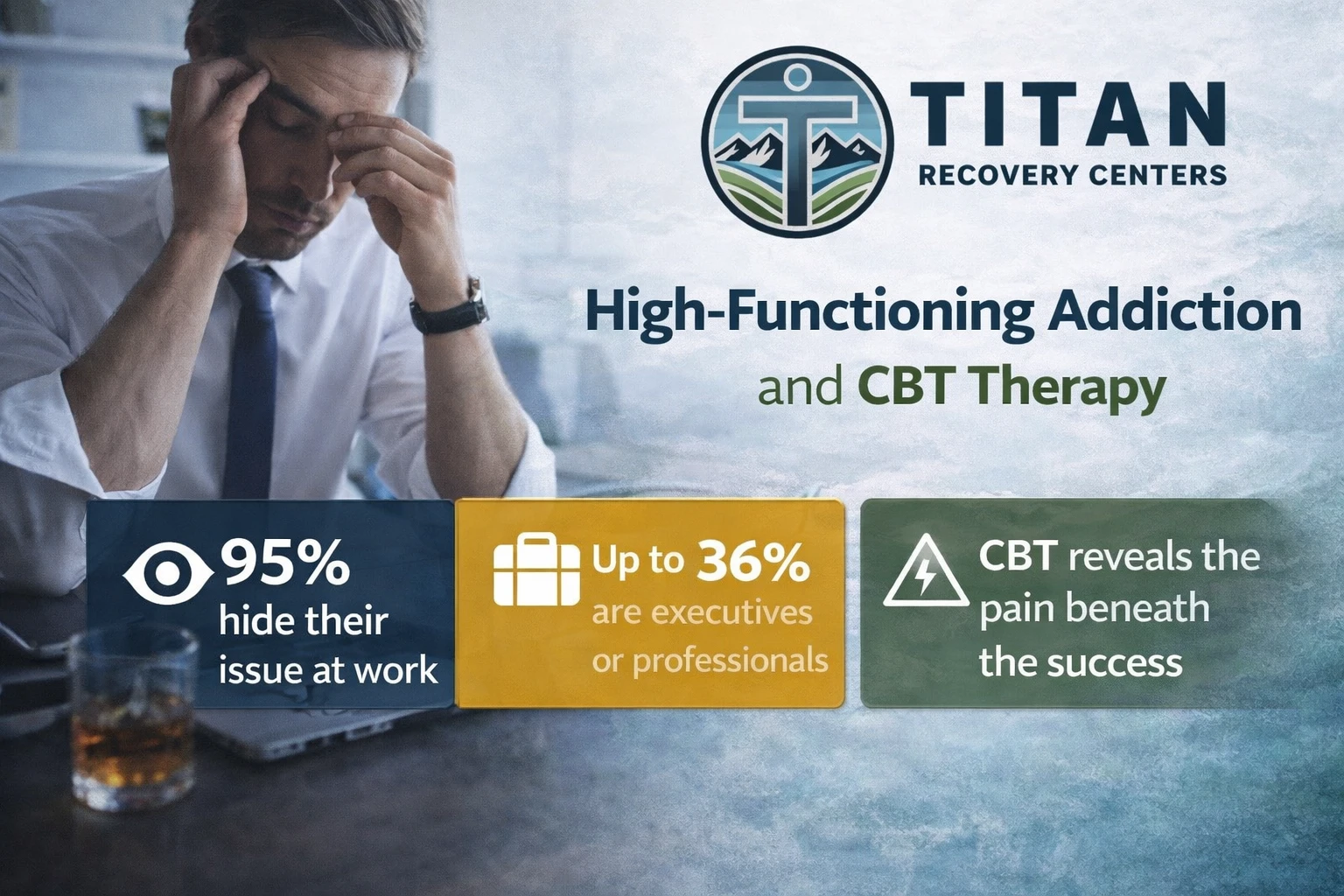
This is the paradox of the high‑functioning addict: success becomes the mask that hides the addiction.
And it’s a mask that can be hard to remove.
At Titan Recovery Centers in Las Vegas, we’ve seen this pattern again and again. Clients come in as achievers—leaders, professionals, parents, talented people whose addiction hasn’t derailed their lives yet but has begun to steal their peace. And one of the most effective therapies we use to help them uncover what’s real beneath that mask is CBT—Cognitive Behavioral Therapy.
Success Doesn’t Make You Immune—It Just Hides the Pain
There’s a stereotype about addiction: chaos, collapse, rock bottom. But real life is messier.
Addiction doesn’t always make someone lose their job or become homeless. Sometimes it just makes someone numb, defensive, and exhausted. Sometimes it makes them chase perfection while numbing the parts of life that feel too heavy to feel.
For high‑functioning individuals, that can look like:
- Waking up early to go to work after a night of drinking
- Managing a team brilliantly but numbing anxiety with pills
- Hosting family dinners on Friday and hiding drinking on Saturdays
- Earning promotions while telling no one about the internal battle
This kind of addiction doesn’t announce itself.
But it is real.
And it is exhausting.
You don’t have to be “out of control” for your drinking or drug use to be a problem. It’s a problem when it’s running your choices, even subtly. And that’s where CBT becomes so powerful—it doesn’t wait for «rock bottom.» It meets you where you are—successful, competent, and hurting underneath.
What CBT Really Does for High‑Functioning Addicts
If you’ve heard of CBT, you might think of it as just a structured therapy or a set of worksheets. That’s part of it—but there’s a deeper purpose.
CBT gives language to the patterns you already live by, the ones you don’t talk about. It helps you see the thoughts that drive the behavior, often automatically and unconsciously, so you can understand them, challenge them, and change how you respond.
Here’s how CBT helps people who are used to “handling things”:
It Makes Hidden Thoughts Visible
You might tell yourself:
- I deserve this after today
- I can handle it
- This isn’t a big deal
- Everyone else drinks too
CBT helps you find the beliefs beneath these statements—the ones that keep the cycle going. Once seen, those thoughts lose some of their power.
It Distinguishes Thought From Truth
Just because your brain says something doesn’t mean it’s true. CBT teaches you to test thoughts, not just accept them.
For example:
“If I don’t have a drink tonight, I won’t relax.”
CBT helps you examine the evidence, the alternatives, and the consequences.
It Breaks the Automatic Response
Right now, your brain is trained to respond a certain way: stress → relief via substance. CBT interrupts that pattern by introducing choice—not judgment.
It Builds Practical Skills
You gain tools you can use outside the therapy room:
- Thought logs
- Reality testing
- Behavioral experiments
- Coping strategies for triggers
These tools aren’t fuzzy. They’re practical. They work even when life feels overwhelming.
And because they’re structured, they fit your analytical, success‑oriented mind.
Let’s Look at How CBT Works in Real Life
Imagine this scenario:
You had a stressful day. You come home, and without even thinking, you pour a drink.
CBT doesn’t ask you to stop caring about the stress. It asks:
- What am I thinking right now?
- What does this thought make me feel?
- How is this feeling influencing my behavior?
- Is this belief accurate, or is it an automatic pattern?
Instead of reacting, CBT invites you to pause.
You might discover:
“I think I need this to relax.”
But then, with guidance, you ask:
“Have I relaxed without substances before?”
“When did this pattern start?”
“Is this habit helping me long-term, or just short-term?”
That pause—that tiny moment of curiosity—is where change begins.
It’s not dramatic. It’s not emotional fireworks. It’s awareness. And for high‑functioning folks, awareness is gold.
Why CBT Works for People Who Aren’t “Falling Apart”
You don’t have to be in crisis for CBT to help. In fact, CBT is ideal for people whose hardship is invisible but persistent.
Some high‑functioning individuals resist therapy because they don’t feel broken. They feel productive. They feel fine. They feel better than most.
That’s exactly the kind of person CBT helps.
CBT doesn’t ask you to admit defeat. It asks you to:
- Notice your thoughts
- Understand their impact
- Learn what’s serving you—and what isn’t
It doesn’t romanticize struggle, and it doesn’t demand vulnerability you’re not ready for. It simply helps you see patterns so you can decide what to do with them.
In many ways, CBT respects the very thing high‑achievers value most: clarity.
A Day in the Life With CBT
Let’s walk through a moment:
You wake up and realize you drank more than you planned last night. You feel frustration first, then guilt.
In the past, your inner voice might have said:
I failed again.
I can’t do anything right.
Might as well keep going.
CBT interrupts this spiral.
Instead of fueling it, you learn to ask:
- “Is it true that one night defines me?”
- “What evidence supports this thought?”
- “What evidence contradicts it?”
- “What’s a more balanced perspective?”
Sometimes that leads to a simple truth like:
I drank more than I wanted. That’s not good. But it doesn’t erase my accomplishments or worth.
That isn’t a sugar‑coated positive; it’s a grounded reality that opens space for choice.
And every choice you make with clarity strengthens your recovery.
The Mask of Success Is Real—And CBT Helps You Take It Off Without Falling Apart
Some people think:
If I admit I have a problem, I’ll lose everything—my reputation, my career, my identity.
That fear is real. And CBT acknowledges it. Rather than denouncing your achievements, CBT helps you understand how your brain learned to cope—and how those coping patterns no longer serve you.
It’s not about losing your success. It’s about reclaiming your life from the behaviors that hide behind it.
You can be driven and self‑aware and still need support. In fact, that combination is often what makes CBT particularly effective.
What Clients Often Realize With CBT
Clients who’ve been high‑functioning for years often tell us things like:
- “I didn’t want therapy because I thought I wasn’t bad enough. CBT showed me I was just tuned out to my own life.”
- “I thought I controlled everything. I didn’t realize how much my thoughts were controlling me.”
- “CBT gave me tools I could use immediately. That was empowering.”
- “I always thought therapy was about emotions—I didn’t realize thinking patterns were driving so much of my behavior.”
These are not just testimonials. They’re insights that come from doing the work, not just talking about it.
If you’re nearby and seeking support, knowing where to begin can be hard. But whether you’re looking for CBT in Henderson, NV, near North Las Vegas, in Spring Valley, NV, or right here in Paradise, Titan Recovery Centers offers CBT services tailored to high‑functioning adults who need clarity more than correction.
FAQs About CBT for High‑Functioning Addiction
Do I have to admit I’m “broken” for CBT to help?
No. CBT doesn’t require you to feel broken or helpless. It works with your existing strengths—your intelligence, your insight, your analytical skills—and helps you apply them inward, not just outward.
Can CBT really help if I’ve been functioning for years?
Yes. In fact, many high‑achievers benefit immensely from CBT because it respects their structure and gives them tools to understand what’s been hidden beneath performance.
Is CBT just about thinking positive?
No. CBT isn’t about pretending everything is fine. It’s about seeing unhelpful thought patterns clearly and choosing responses that actually serve your goals.
How long does CBT take to show results?
It varies. Some people notice clarity within weeks. Others take longer as deeper patterns unfold. What matters most is consistency, not speed.
Is CBT enough on its own?
For many high‑functioning individuals, CBT is extremely effective. In some cases, it’s used alongside other therapies for deeper work—but CBT often lays the foundation for real insight and sustainable change.
What if I don’t want to talk about feelings?
CBT doesn’t require you to dive immediately into emotions. It starts with thinking patterns and logic—so you can approach change at a pace that feels manageable.
You Can Have Success And Health
Success without peace is still a kind of suffering.
And living with a mask—no matter how well worn—is still a form of confinement.
You don’t need to collapse for therapy to help you.
You just need to be honest enough to want something different.
CBT can help you see beneath the performance.
It can help you understand why you come back to substances even when everything else in your life seems organized.
And it can help you rebuild from the inside out—without losing the parts of you that you’re proud of.
Call (888) 976‑8457 to learn more about our Cognitive Behavioral Therapy in Las Vegas, Nevada.