

I didn’t expect to feel numb.
After months of early recovery work, rigid routines, and “doing everything right,” I walked into another day feeling… flat. It wasn’t despair. It wasn’t panic. It was the quiet disappearance of me. I’d stayed sober, kept appointments, built healthy habits—yet I felt like a ghost walking through my own life.
That’s when I first learned about dialectical behavior therapy (DBT). It came at a moment when healing felt more like maintenance than transformation. I thought DBT was just another acronym I’d have to memorize. Instead, it became the inner compass that helped me find my way back to myself.
Early on in treatment, my therapist invited me to explore DBT skills through Titan Recovery Centers’ DBT program, introducing me to tools that didn’t just manage symptoms—but helped me understand my own emotional landscape in a way I never had before. Somewhere between emotion regulation drills and mindfulness exercises, I began to feel alive again.
Below, I’ll share what DBT truly did for me—how it pulled me out of numbness, helped me release shame, and offered a way back into connection that I didn’t think was possible after all I’d endured. Whether you’re months or years into your recovery journey, if you’ve ever felt stuck—not spiraling, just stalled—this reflection might speak to you.
What It Felt Like Before DBT: Living, but Unconnected
Most of my early recovery was about staying safe. I learned to avoid triggers, I built coping rituals, I showed up for therapy and support groups—and I did it with discipline.
But there was a trade-off I didn’t anticipate: I stopped feeling. Yes, I felt anxiety, but the deep emotional palette of life—the colors between black and white—felt absent. I wasn’t regressing, but I wasn’t thriving either.
I could talk about emotions in theory. I could identify them on worksheets. But in the moment—to actually feel and sit with them? That was another story.
It felt like having a radio that played only the static between songs. I was technically tuned in—but I couldn’t hear the music of my own life.
What DBT Really Means: Skills With Purpose
When I enrolled in DBT at Titan, I thought it would be about managing crisis moments. And yes, it does that—but DBT is more than emergency tools. It’s a framework for living deliberately.
DBT stands for dialectical behavior therapy. The word “dialectical” can sound intimidating—it implies synthesis and balance. But in practice, it’s about holding two truths at once: I am doing my best, and I can still grow. I can be hurting, and still choose what helps.
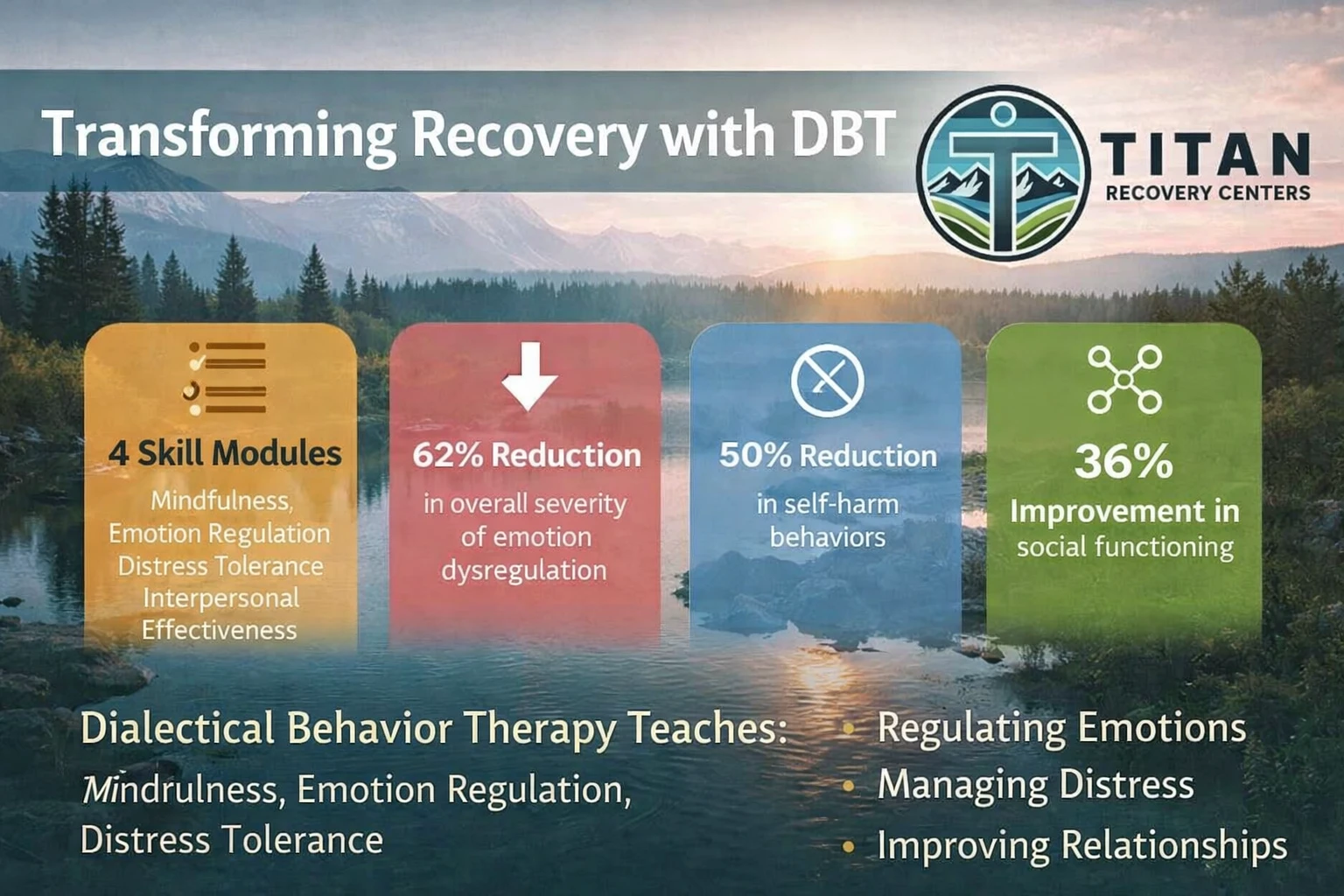
The therapy is structured around four core skill modules:
- Mindfulness: learning to notice thoughts and feelings without judgment.
- Emotion Regulation: understanding what emotions are doing inside you—and how to respond rather than react.
- Distress Tolerance: survival skills for pain that can’t immediately be changed.
- Interpersonal Effectiveness: how to ask for what you need and set boundaries with others.
These were not abstract concepts. They were practices—weekly skills sessions, role-plays, self-check-ins, and behavior tracking. Slow at first, awkward at times, but ultimately transformative.
Mindfulness: Feeling Without Fear
The first DBT skill that struck me was mindfulness—but not in a spiritual, touchy-feely sense. It was practical. It was moment-to-moment.
In early recovery, I avoided emotions because they felt dangerous. A surge of sadness could easily spiral into impulsive urges. So the reflex was to shut down—to flatten.
But mindfulness taught me something that changed everything: Emotions are not enemies. They are data.
DBT doesn’t ask you to cling to feelings or let them crash over you. It asks you to notice:
- What is happening physically?
- What thoughts arise?
- What urges show up?
Without immediately acting on them.
That distinction—that pause between feeling and reacting—is where freedom lived.
For the first time in a long time, I learned to sit with sadness without feeding it, to notice joy without dismissing it. It wasn’t instantaneous relief—it was presence.
Emotion Regulation: From Surviving to Understanding
Emotion regulation in DBT isn’t about suppressing emotions. It’s about mapping them.
Before DBT, big emotions felt dangerous. Small ones felt inconsequential. Either way, I responded impulsively or shut down entirely.
DBT gave me a vocabulary for what was happening inside:
- What triggers certain emotional reactions?
- What patterns lead from feeling to behavior?
- How can I choose a response that actually aligns with my goals?
These skills helped me understand the why behind my reactions—not to justify them, but to understand them. It was like getting a user manual for a machine I’d been operating blindly.
Emotion regulation helped me see frustration as frustration—not failure. It helped me see joy as something to savor—not fear it. It didn’t make emotions disappear. It helped me grow comfortable enough to live with them.
Distress Tolerance: Riding the Waves
Distress tolerance was a lifesaver early on—literally.
There are moments in recovery where pain doesn’t change immediately. And trying to force change in those moments often makes things worse.
DBT gave me survival strategies for these moments:
- Grounding techniques to stay present.
- Distraction tools that didn’t numb but stabilized.
- Self-soothing practices that weren’t addictive.
It wasn’t about pretending pain didn’t exist. It was about learning how to sit through it without collapsing or escaping.
There’s a profound difference between numbing pain and tolerating it. Distress tolerance taught me the latter. And in that space of tolerating, I found strength I didn’t know I had.
Interpersonal Effectiveness: Real Connection Again
One of the most surprising changes DBT brought was in my relationships.
In early recovery, I learned to show up and behave responsibly. But I didn’t know how to ask for what I needed. I didn’t know how to set limits. I didn’t know how to express hurt without guilt or anger.
Interpersonal effectiveness skills taught me:
- How to communicate clearly and assertively.
- When to say no—and how to stay compassionate in doing it.
- That vulnerability doesn’t mean weakness.
Before DBT, I was physically present with people but emotionally absent. I could maintain friendships—but not nurture them. DBT gave me permission to be honest, to express need, to listen deeply without turning it into self-criticism.
Slowly, my connections deepened. Not because people changed—but because I showed up more fully.
Becoming Present: Not Perfect
One of the most beautiful lessons DBT taught me was this: healing isn’t linear.
Some days I practiced every skill and felt grounded. Other days I forgot, fell back on old patterns, and felt defeated.
But here’s the crucial thing: DBT taught me to be gentle with myself in that process.
DBT doesn’t require perfection. It asks for persistence.
There’s a beautiful metaphor I carry with me: DBT isn’t a map to a destination. It’s a compass for direction.
It doesn’t make the storms disappear. It helps you navigate them.
In places like Henderson, Nevada, I’ve seen firsthand how vital this kind of therapy is for people rebuilding their emotional presence after long-term recovery. The emotional tools DBT offers are not just clinical—they’re deeply human.
How This Changed My Everyday Life
Before DBT:
- I avoided emotions.
- I feared conflict.
- I lived in autopilot.
- I felt distant from others and myself.
After DBT:
- I name emotions without self-judgment.
- I communicate honestly with loved ones.
- I tolerate discomfort without fleeing.
- I feel present in my own life.
It didn’t happen overnight. It didn’t happen without struggle. But it happened. And it changed how I face each day—with more depth, more awareness, and more connection.
What I’d Say to Someone Who Feels Like I Did
If you’re reading this and feeling a familiar ache—like life has lost its color—know this:
You are not broken.
You are in between chapters.
And DBT may just be the tool that helps you turn the page.
You don’t have to be in crisis to benefit from these skills. You don’t have to wait until something “bad” happens. Healing isn’t only for surviving—it’s for living fully.
Whether you’re in a big city or a smaller community like North Las Vegas, Nevada, access to DBT matters. You deserve therapy that doesn’t just help you survive—but helps you reconnect.
Before You Go: Common Questions About DBT
What is DBT good for?
DBT was originally developed for people struggling with emotional instability and self-destructive behaviors, but it’s now used to help anyone seeking better emotion management, interpersonal skills, and distress tolerance.
Do I need to be in crisis to start DBT?
No. DBT isn’t only for crisis management. It’s a long-term skills framework that supports ongoing emotional growth and connection.
Is DBT the same as talk therapy?
Not exactly. Talk therapy explores feelings and patterns, but DBT focuses on skills practice—active tools you use in daily life, not just in a session.
How long does DBT take?
That varies by individual. Some people engage in DBT for several months; others continue for a year or more. It’s less about duration and more about how consistently you apply the skills.
Can DBT help with relationships?
Yes. Interpersonal effectiveness skills are a cornerstone of DBT—and help with communication, boundary-setting, and healthy connection.
If you’re curious about how DBT can help you reconnect with your emotional life and strengthen your recovery, call (888) 976-8457 to learn more about our Dialectical Behavior Therapy services in Las Vegas, Nevada.
You deserve to feel present, connected, and alive—not just safe or functional. And there are tools that can help you get there.