

Maybe you’re not in crisis.
Maybe you’re just tired of the pattern.
Tired of saying, “I’m fine,” when you’re not. Tired of needing something—wine, weed, scrolling, distractions—to smooth out emotions that feel sharper than they should. If you’ve been sober curious and wondering whether something deeper is driving your reactions, you’re not dramatic. You’re paying attention.
And that’s where EMDR comes in.
Within the first few conversations we have at Titan Recovery Centers, many people realize their coping isn’t random—it’s connected. If you’ve already explored our core approach to EMDR therapy, you know it’s not about labeling you. It’s about helping your nervous system finally exhale.
Let’s walk through how EMDR helps you untangle trauma—step by step.
Step 1: Notice The Pattern Without Judging Yourself
Before healing, there’s awareness.
You might notice:
- You overreact in conflict and regret it later
- You shut down emotionally when things get intense
- You reach for a drink to quiet anxiety
- You replay conversations for hours
- You feel shame that doesn’t match the situation
If you’re sober curious, you may already suspect something is fueling this cycle.
Here’s the truth: coping behaviors often develop for a reason.
Your nervous system learned something at some point. EMDR begins by identifying those moments—not to blame, not to dramatize, but to understand.
You can’t untangle a knot by pretending it isn’t there.
Step 2: Understand How Trauma Actually Gets “Stuck”
Trauma isn’t always a headline event.
It can be:
- Chronic criticism
- Bullying
- Emotional neglect
- Sudden loss
- Growing up in unpredictability
- Being the “strong one” too early
When something overwhelming happens, your brain sometimes stores it in survival mode. That means years later, your body reacts like the danger is happening now.
That’s why a small disagreement feels catastrophic.
Why rejection feels unbearable.
Why you need something to take the edge off.
EMDR helps your brain reprocess those stored memories so they stop firing like alarms.
It doesn’t erase your past.
It lowers the emotional charge attached to it.
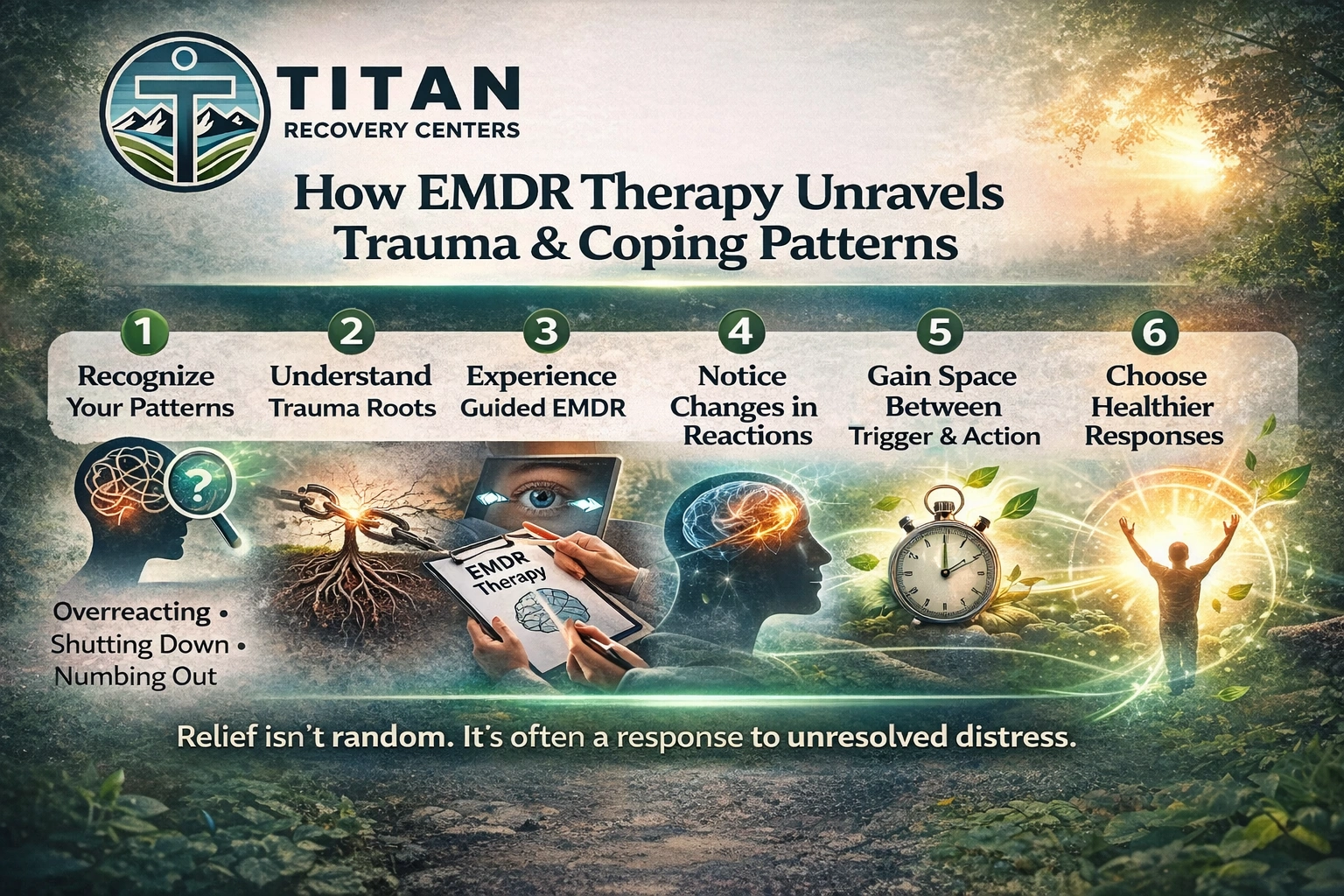
Step 3: Experience EMDR In A Structured, Safe Way
EMDR stands for Eye Movement Desensitization and Reprocessing.
It uses bilateral stimulation—guided eye movements, tapping, or tones—while you briefly bring up specific memories.
Here’s what surprises most people:
You’re not reliving trauma for hours.
You’re not losing control.
You’re not forced to share everything in detail.
The process is paced. Contained. Structured.
First, we build grounding skills. Emotional regulation tools. Safety strategies.
Then, when you’re ready, we target specific memories.
Over time, many people say things like:
“That memory doesn’t hit the same.”
“I can think about it without spiraling.”
“It feels distant now.”
That shift matters more than people expect.
Step 4: Connect Trauma To Your Coping
This is where things start clicking.
Substances often function as regulators.
They:
- Soften social anxiety
- Mute shame
- Slow racing thoughts
- Create temporary calm
If your nervous system has been running hot for years, numbing can feel like relief.
When trauma is processed through EMDR, the nervous system doesn’t stay on high alert in the same way. And when the body feels safer, the urge to self-soothe often decreases naturally.
Not because someone told you to stop.
Because you don’t need it the same way anymore.
For individuals exploring trauma-informed support in Henderson, Nevada, this integration of mental health and substance use care often becomes the turning point—they realize their coping wasn’t weakness. It was adaptation.
Similarly, those seeking structured EMDR support in North Las Vegas, Nevada frequently discover that what they labeled as “self-sabotage” was actually unresolved distress looking for relief.
Understanding that changes everything.
Step 5: Notice The Space Between Trigger And Reaction
After several EMDR sessions, changes often show up subtly.
You pause before reacting.
You tolerate discomfort longer.
Conflict feels stressful—but survivable.
Shame doesn’t spiral as deeply.
This is nervous system healing.
When trauma is processed, your brain stops scanning for threat in the same way. You gain space between feeling and action.
And space is where choice lives.
Choice is what sober curiosity is really about.
Step 6: Decide What You Want Your Life To Feel Like
You don’t have to hit rock bottom to deserve peace.
You don’t have to claim a label to seek clarity.
If you’re sober curious, it might not be about quitting forever. It might be about understanding why you reach for something in the first place.
EMDR helps you answer that question honestly.
What are you avoiding?
What are you protecting?
What are you carrying that isn’t yours anymore?
Healing doesn’t require drama.
It requires willingness.
What Makes EMDR Different From Just Talking About It?
Insight is helpful.
But insight alone doesn’t always change how your body reacts.
You can understand your childhood perfectly and still feel panic in certain situations.
EMDR works at the level of the nervous system. It doesn’t just help you explain your triggers—it helps reduce their intensity.
That’s why many people describe it as “lighter.”
Not because the work is shallow.
But because the emotional weight decreases.
It’s like carrying a backpack full of rocks for years and finally realizing you can take some of them out.
What If You’re Scared To Start?
That’s normal.
Being unsure doesn’t mean you’re not ready. It means you care about doing this safely.
At Titan Recovery Centers, EMDR is integrated into comprehensive care. That means you’re not just doing trauma work in isolation. You’re supported holistically—emotionally, clinically, and practically.
You move at your pace.
No pressure.
No forced identity.
No dramatic ultimatums.
Just structured healing.
Frequently Asked Questions About EMDR
Do I Have To Relive Everything In Detail?
No. EMDR involves brief activation of a memory while guided by a clinician. You’re never forced to share more than you’re ready to.
How Long Does EMDR Take?
It varies. Some memories process in a few sessions. More complex histories require longer treatment. Your plan is individualized.
Will EMDR Make Me Stop Drinking Or Using Immediately?
Not necessarily. EMDR isn’t about forcing abstinence. It reduces emotional intensity behind triggers, which often makes healthier choices easier.
Can EMDR Work If I Don’t Think My Trauma Was “That Bad”?
Yes. Trauma is about impact, not comparison. Many people minimize their experiences until they see how strongly those moments shaped their reactions.
Is EMDR Only For Severe PTSD?
No. EMDR is effective for anxiety, shame patterns, emotional reactivity, and unresolved distress that influences coping behaviors.
What If I Start And Change My Mind?
You remain in control. Treatment is collaborative. If something feels too intense, pacing adjusts.
You Don’t Have To White-Knuckle Clarity
If you’ve been sober curious for a while, that curiosity is telling you something.
Maybe you don’t want to keep numbing.
Maybe you want to understand your reactions instead of managing them.
Maybe you’re ready to feel steady without external relief.
You don’t have to untangle this alone.
Call (888) 976-8457 to learn more about our EMDR Therapy in Las Vegas, Nevada.
