

I didn’t think I was “bad enough” for medical detox.
I just thought I was young. Social. A little stressed. Maybe dramatic.
But walking into medical detox forced me to confront something I’d been avoiding for years: my relationship with substances wasn’t casual. It was coping. And it was running the show.
If you’re young and sober—or thinking about it—and feeling like the odd one out, this is what detox actually taught me.
Not the brochure version. The real version.
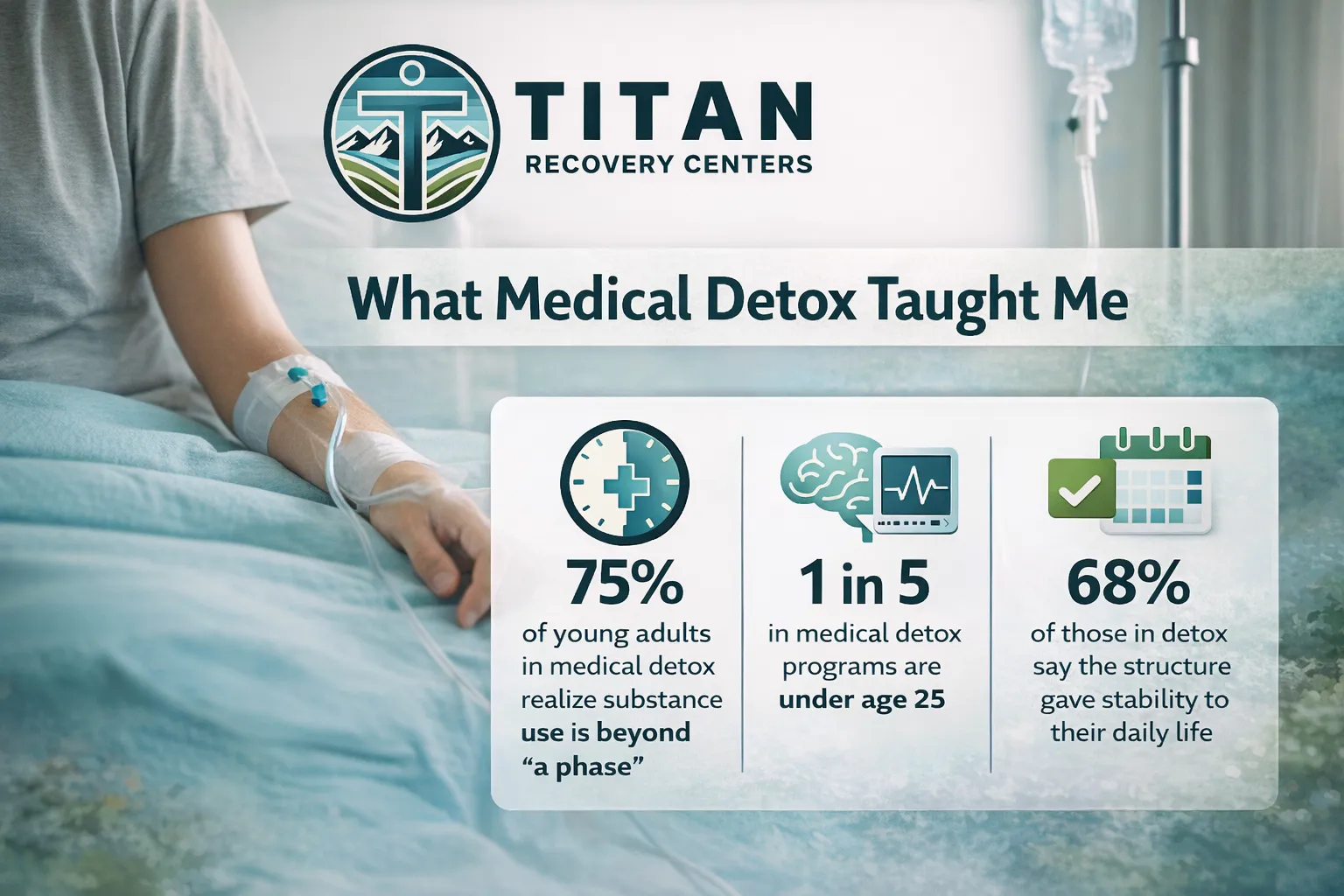
1. Medical Detox Made Me Admit It Wasn’t “Just a Phase”
I told myself I’d grow out of it.
College culture. Party scene. Stress relief. Everyone was doing it. Or at least that’s what it looked like online.
Medical detox interrupted that story. When professionals calmly explained what was happening in my body—tolerance, dependence, escalating use—I couldn’t hide behind “it’s just temporary” anymore.
Phases don’t require medical supervision.
That realization stung. But it also cleared the fog.
2. My Body Was Working Overtime to Keep Up
I used to wear my tolerance like a badge of honor.
“I can handle it.”
“I don’t black out.”
“I’m fine the next day.”
Detox taught me that my body had been adapting just to maintain baseline function. Higher amounts. More frequent use. Less effect.
That’s not strength. That’s survival.
Medical detox helped me see how hard my nervous system had been working to compensate for my choices. My body wasn’t weak—it was exhausted.
3. Withdrawal Was Uncomfortable, But Clarity Was Louder
Yes, detox can involve physical symptoms. Restlessness. Sweats. Sleep disruptions. Mood swings.
But what surprised me most wasn’t the physical part.
It was the mental noise.
Without substances dulling everything, my thoughts were sharp. Unfiltered. Sometimes overwhelming.
Medical detox didn’t just stabilize my body—it revealed how much I’d been numbing anxiety, insecurity, and loneliness.
And that clarity? It was uncomfortable. But it was honest.
4. I Used Substances to Feel Less Socially Awkward
This one hurt.
I told myself I drank or used to have fun. To relax. To celebrate.
But detox gave me space to reflect. And the truth was simpler: I didn’t like how I felt in my own skin.
Substances helped me:
- Talk more freely
- Laugh louder
- Care less about what people thought
- Feel less like the “weird one” in the room
Medical detox forced me to ask a hard question:
If I need something external to feel normal… what does that say about how I see myself?
That question started my real recovery.
5. Being Young Didn’t Protect Me
I thought addiction was something that happened later. After years of damage. After losing jobs or marriages.
I hadn’t “lost everything.” I still had friends. School. A job.
But dependency doesn’t wait for you to hit a dramatic bottom.
In medical detox, I met people my age who looked completely functional from the outside. Athletes. Students. Professionals.
Addiction doesn’t care about your resume.
It cares about repetition.
6. Medical Detox Gave Me Structure My Life Didn’t Have
My life before detox looked busy. But it wasn’t stable.
Sleep was inconsistent. Moods were unpredictable. Decisions were impulsive.
Medical detox introduced structure:
- Scheduled check-ins
- Medical monitoring
- Regular meals
- Sleep routines
- Accountability
At first, it felt restrictive.
Then it felt safe.
That structure showed me how chaotic my “normal” had become. Stability wasn’t boring—it was grounding.
7. Cravings Are Waves, Not Orders
This was a game changer.
In active use, a craving felt like an emergency. Immediate. Urgent. Non-negotiable.
During medical detox, I learned something powerful: cravings peak and pass.
They rise. They crest. They fall.
When you’re medically supported and not alone, you can ride them instead of obeying them.
That shift—from reacting to observing—changed how I see every urge now.
I don’t have to answer every impulse.
8. I Wasn’t Weak. I Was Conditioned.
I carried so much shame walking into detox.
I thought I just didn’t have enough willpower.
But the medical team explained how repeated substance use rewires reward pathways. How cues trigger cravings. How stress strengthens dependency loops.
Hearing the science didn’t excuse my choices—but it reframed them.
This wasn’t about being broken.
It was about conditioning.
And conditioning can be unlearned.
9. Detox Wasn’t The End—It Was The Reset
Before going in, I thought medical detox was the “big dramatic thing.”
It wasn’t.
It was stabilization.
It cleared my system so I could think clearly enough to actually start therapy, build coping skills, and rebuild trust with myself.
Detox alone doesn’t fix your relationship with substances.
It creates space to examine it.
That space is where the real work begins.
10. Feeling Like The “Weird One” Is Temporary
This might be the biggest lesson of all.
When you’re young and sober, you feel hyper-visible. Like everyone else is carefree and you’re the only one making serious decisions.
But here’s the truth detox helped me see:
A lot of people are struggling quietly.
Some are just earlier in the story.
In medical detox, I met people from different neighborhoods and backgrounds—some coming from places like Spring Valley, Nevada, others from Paradise, Nevada—all carrying the same hidden fear: “Is it just me?”
It wasn’t.
It never is.
What Medical Detox Actually Is
Let’s clear up what medical detox means.
Medical detox is:
- Supervised withdrawal in a safe setting
- Monitoring of physical symptoms
- Support for managing discomfort
- A bridge into ongoing treatment
It is not:
- A punishment
- A moral judgment
- A dramatic overreaction
- A lifelong label
When I first explored medical detox programs, I thought it meant I had failed.
What it actually meant was I was done pretending I could handle it alone.
And that shift built trust—not just in the process, but in myself.
The Part No One Talks About: Identity After Detox
Detox isn’t just physical separation from substances.
It’s identity disruption.
Who am I at parties?
Who am I under stress?
Who am I without a social crutch?
For young people especially, substances can become part of personality.
Medical detox doesn’t erase who you are.
It reveals who you are without enhancement.
That discovery can feel raw. But it’s also freeing.
You realize your humor doesn’t disappear.
Your creativity doesn’t vanish.
Your friendships don’t automatically collapse.
What changes is your dependency—not your essence.
Frequently Asked Questions About Medical Detox
Do I really need medical detox if I’m young?
Age doesn’t determine dependency. If you’ve developed tolerance, experience withdrawal symptoms, or struggle to stop despite consequences, medical detox may be appropriate regardless of age.
Is medical detox painful?
Withdrawal can be uncomfortable, but medical supervision significantly reduces risk and manages symptoms. The goal is safety and stabilization—not suffering.
How long does medical detox last?
Duration varies depending on the substance, frequency of use, and individual health. Some detox programs last a few days, while others extend longer for certain substances.
Can I detox at home instead?
Home detox can be risky, especially for substances like alcohol or benzodiazepines. Medical detox provides monitoring to prevent dangerous complications and manage symptoms effectively.
What happens after detox?
Detox is the first step. Ongoing treatment—such as therapy, outpatient programs, or residential care—addresses the psychological and behavioral aspects of substance use.
Will detox label me forever?
No. Medical detox is a treatment decision, not an identity. It’s a health intervention, not a life sentence.
If You’re Young And On The Fence
If you’re reading this and thinking, “I’m not that bad,” I get it.
I said that too.
But if substances are:
- Running your schedule
- Controlling your mood
- Making you anxious about running out
- Creating secrecy
- Affecting sleep, school, or relationships
That’s worth paying attention to.
Medical detox isn’t about admitting defeat.
It’s about choosing clarity.
And clarity is powerful.
You don’t have to wait until everything falls apart. You don’t have to lose years proving you can handle it.
If you’re considering your options and want real answers, not judgment, Call (888) 976-8457 to learn more about our Medical Detox in Las Vegas.
