
Somewhere along the way, life got quiet. Not peaceful quiet—numb quiet. You show up. You do the job. You stay sober. But the aliveness that once felt close? It’s faded. Maybe you laugh less. Feel less. Want less. And you’re wondering why.
That’s not failure. That’s a signal.
You’re Not Broken—You’re Burned Out
Sobriety saved your life. But now, it might feel like it’s just… your life. The same routines. The same emotional fatigue. No relapse. No crisis. Just a subtle but heavy sense that you’re surviving, not thriving.
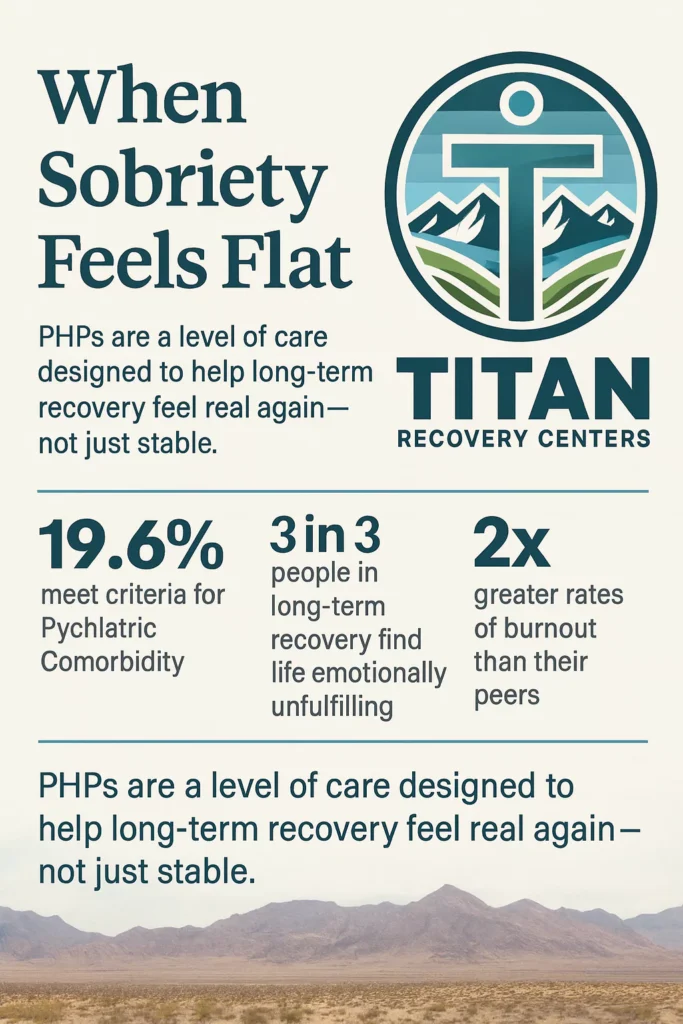
That emotional flatness? That sense of floating outside your own life? It’s not uncommon among people in long-term recovery. And it’s not a reflection of weakness—it’s your system asking for deeper care.
A partial hospitalization program (PHP) isn’t about fixing what’s broken. It’s about reconnecting to what still matters when the old motivators no longer do.
Partial Hospitalization Programs Aren’t Just for Crisis
PHP has a reputation—mostly outdated. Many still assume it’s only for people fresh out of detox or coming off a crisis. That’s simply not true.
At Titan Recovery Centers, we see a different kind of client walk through our Las Vegas doors:
- The professional who’s been holding it together
- The parent who’s been prioritizing everyone else
- The sober person who’s lost their sense of self
PHP is for people who function well but feel deeply off. It’s for those who don’t need to be hospitalized but aren’t getting what they need from weekly outpatient. It’s for those quietly wondering, “Is this all there is?”
Healing Doesn’t Require Hitting Pause on Your Career
You shouldn’t have to choose between emotional health and job security. The myth that healing requires dropping everything for 30 days keeps a lot of people stuck longer than they need to be.
Our partial hospitalization program in Las Vegas is structured for people who want real support without walking away from their responsibilities. You attend treatment during the day—typically five days a week, for several hours—and return home each evening.
That means you can:
- Keep your home life intact
- Maintain a part-time or flexible work schedule
- Access more support without upending your world
It’s not a luxury. It’s a lifeline.
What a Day in PHP Actually Looks Like
No cold hospital beds. No endless lectures. No one-size-fits-all therapy.
Here’s what your day might include at Titan Recovery Centers’ PHP:
- Morning check-in and grounding practices to help you connect and reset
- Group therapy sessions that go beyond surface-level—where you’re seen and challenged
- Individual sessions with a licensed therapist focused on deeper emotional patterns
- Skill-building and experiential therapy, like emotional regulation, boundary setting, or trauma processing
- Lunch and breaks, with time to breathe, reflect, and reset
It’s a rhythm designed to stir what’s gone quiet. To help you feel again. To meet you where you are—not where you were.
You Don’t Have to Settle for “Fine”
One of the hardest things to admit in recovery is that “fine” isn’t cutting it anymore. You’re grateful to be sober. You know how bad it got. But that doesn’t mean this is enough.
It’s okay to want more.
It’s okay to ask for help even when you “should be okay.”
It’s okay to say: “I’m doing the work—but I feel like I’m going through the motions.”
PHP doesn’t mean you’re failing. It means you’re ready to feel again. To challenge yourself emotionally. To stop living in neutral.
Real Recovery Evolves—And So Should Your Support
Recovery isn’t a one-size-fits-all blueprint. What helped you in year one might not hold you in year five. That’s not regression. That’s growth.
Just like physical fitness requires evolving routines to stay strong, emotional fitness does too. PHP gives you the structured, immersive space to explore deeper healing—without starting over.
If your support system hasn’t kept pace with your needs, you’re not alone. Many alumni come back not because they’ve relapsed—but because they want to stay grounded in something real. Something alive.
FAQ: Understanding PHP for Long-Term Recovery
What is a partial hospitalization program (PHP)?
A PHP is a structured outpatient treatment that offers intensive therapy during the day—typically 5 days per week—while allowing you to live at home. It bridges the gap between full-time residential care and standard outpatient therapy.
Is PHP only for people in crisis?
Not at all. At Titan Recovery Centers, many PHP clients are high-functioning and sober, but emotionally disconnected, burned out, or stuck. PHP is a proactive step, not just a reactive one.
Can I work while in PHP?
Yes, many PHP clients work part-time, freelance, or adjust their schedules. We help you find a balance that supports both your healing and your responsibilities. PHP is structured but not rigid.
Do I need to have relapsed to qualify for PHP?
No. You do not need to relapse—or even come close—to benefit from PHP. If you’re feeling emotionally unwell, flat, anxious, or spiritually disconnected, PHP can help re-center you.
How do I know if PHP is right for me?
If individual therapy isn’t moving the needle anymore, or if you’re feeling stuck despite staying sober, PHP might be the level of care you need. We offer free consultations to help assess your needs without pressure.
What types of therapy are included in your PHP?
Our program includes evidence-based approaches like CBT, DBT, trauma-informed care, somatic techniques, group process, and more. We tailor your care plan based on your needs and goals.
Reconnect to the You Who Wanted More
Sobriety wasn’t supposed to be a sentence. It was supposed to set you free. And if it doesn’t feel like that anymore, you’re allowed to want more.
You don’t have to go back to crisis to deserve care.
You don’t have to burn it all down to rebuild something better.
You don’t have to choose between work and healing.
At Titan Recovery Centers, our partial hospitalization program in Las Vegas is designed to hold space for exactly this kind of in-between—the stuck, the disconnected, the quietly aching. And we’ll meet you there, without judgment.
Ready to reconnect with yourself?
Call (888) 976-8457 or visit to learn more about our partial hospitalization program services in North Las Vegas, NV. You don’t have to trade healing for stability—we’ll help you hold both.
