

You didn’t plan to ghost.
You didn’t wake up and decide, “I’m going to burn this bridge.”
You just stopped answering calls. Stopped showing up. Let the silence stretch until it felt too big to fix. And now the idea of walking back into medical detox feels heavier than the withdrawal itself.
If that’s where you are, I want you to hear this clearly: disappearing does not disqualify you from coming back.
If you need to understand what detox involves before taking that step, you can review the medical detox program here. Then come back to this page. We’re going to talk about how to actually walk through the door again—without letting shame run the show.
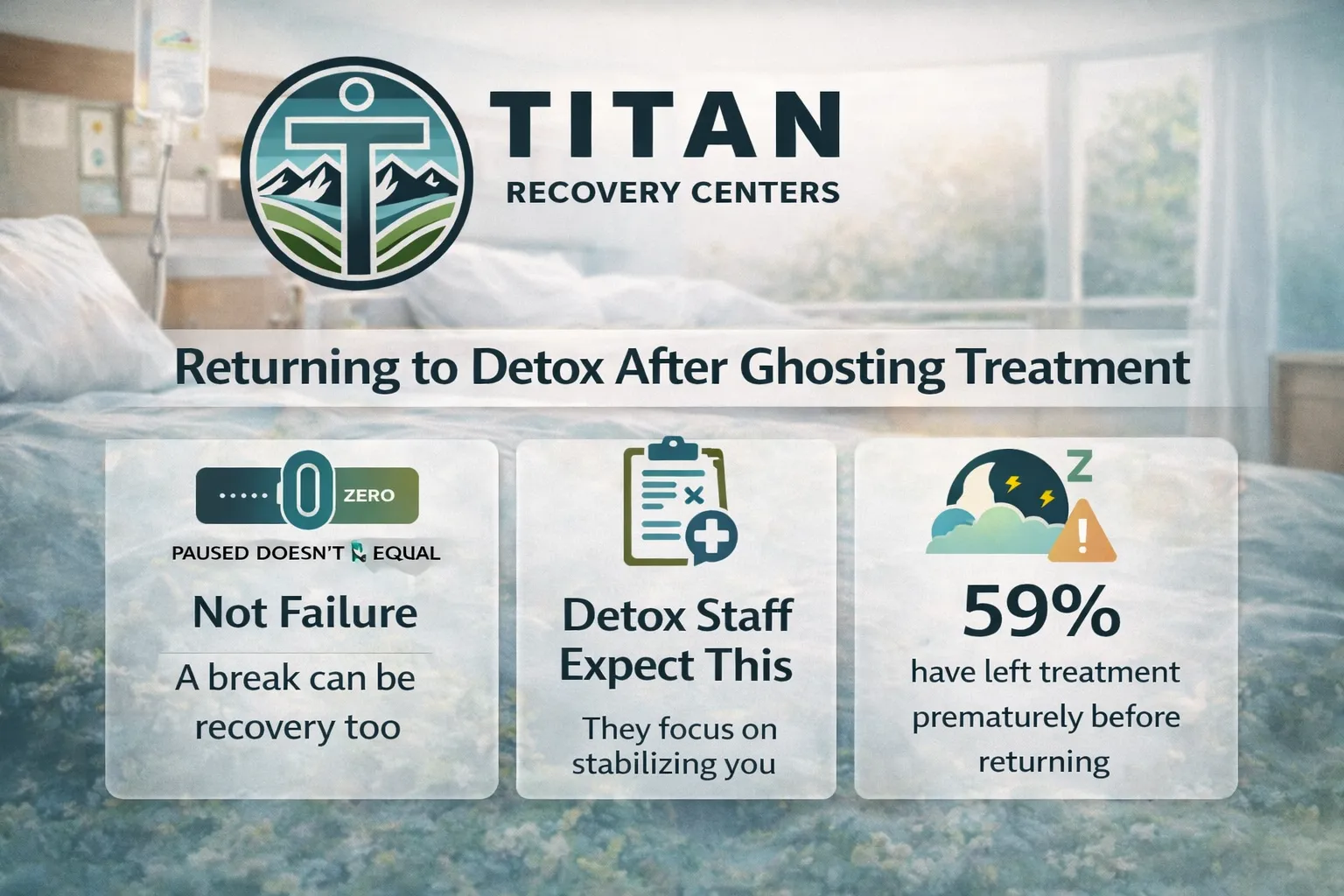
Step 1: Call It A Pause, Not A Failure
Shame loves dramatic language.
“You blew it.”
“You wasted everyone’s time.”
“You’re back at zero.”
Let’s correct that.
You paused.
Something overwhelmed you. Maybe it was cravings. Maybe it was fear. Maybe being seen in treatment felt too exposed. Maybe relapse crept in quietly and you didn’t know how to admit it.
Ghosting treatment doesn’t mean you don’t want recovery. It usually means you wanted it so badly that struggling felt unbearable.
A pause is not the same thing as defeat.
And medical detox doesn’t require a perfect attendance record.
Step 2: Understand That Detox Staff Have Seen This Before
You think you’re the only one who disappeared mid-treatment.
You’re not.
People leave. People relapse. People panic. People isolate.
Professionals working in medical detox understand that ambivalence is part of recovery. Shame is common. Avoidance is predictable.
When someone returns, the reaction is not, “How dare you.”
It’s, “Let’s stabilize you.”
That’s the focus. Safety first. Always.
For individuals reaching back out from Spring Valley, Nevada, the conversation isn’t about scolding. It’s about medical assessment and support.
The same is true for those reconnecting from Paradise, Nevada. The question isn’t where you’ve been. It’s what you need now.
Step 3: Make The Call Before You Feel Ready
If you wait to feel brave, you may never dial.
Readiness is a moving target. Shame keeps shifting it further away.
The truth? You don’t need a speech. You don’t need the perfect explanation.
You can say:
“I left. I’m using again.”
“I’m not okay.”
“I need to come back.”
That’s enough.
Entering medical detox again doesn’t require confidence. It requires honesty.
And honesty can be shaky. It still counts.
Step 4: Expect The First Conversation To Be Clinical, Not Emotional
When you re-enter detox, the initial process is structured.
You’ll likely go through:
- A substance use assessment
- A physical health screening
- Questions about recent use
- Evaluation of withdrawal risk
This isn’t interrogation. It’s safety mapping.
The goal is to determine:
- What substances are currently in your system
- What withdrawal symptoms to expect
- Whether medication is appropriate
- How to monitor vital signs
Medical detox is clinical for a reason. It removes drama and focuses on stabilization.
You may walk in carrying shame.
You’ll walk into a system focused on safety.
Step 5: Let Detox Be A Reset, Not A Punishment
If you’re coming back after disappearing, it’s easy to frame detox as something you “deserve.”
Like a consequence.
It’s not.
Medical detox is a medical intervention.
Your nervous system doesn’t care that you feel guilty. It cares about regulation.
Detox helps:
- Reduce withdrawal complications
- Stabilize heart rate and blood pressure
- Restore sleep patterns
- Ease acute cravings
- Create mental clarity
It’s not about atonement.
It’s about physiology.
You are not being punished. You are being stabilized.
Step 6: Prepare For The Shame Voice To Get Loud
Shame won’t disappear just because you walked back in.
It may whisper:
“You’re embarrassing.”
“They won’t take you seriously.”
“This proves you can’t do it.”
That voice is not evidence.
It’s fear.
Many people who return to medical detox after ghosting describe the same internal conflict: relief mixed with embarrassment.
Relief that the hiding stops.
Embarrassment that they needed to come back.
Both can exist at once.
And neither disqualifies you from care.
Step 7: Stay Long Enough For Your Brain To Catch Up
The first 24–48 hours can feel awkward.
You may want to leave again. Especially if withdrawal discomfort spikes or if self-criticism intensifies.
Stay.
Medical detox is about stabilization, and stabilization takes time.
By day two or three, many people experience subtle shifts:
- Sleep improves
- Anxiety levels drop
- Physical symptoms decrease
- Thinking becomes clearer
Clarity is powerful.
And clarity is exactly what shame tries to prevent.
Stay long enough to feel your nervous system settle.
Step 8: Be Honest About What Made You Leave
You don’t have to unpack everything on day one.
But at some point, it’s important to ask:
- Did I leave because I relapsed?
- Did I feel exposed in group therapy?
- Was I afraid of failing publicly?
- Did I feel overwhelmed by structure?
Re-entering medical detox gives you a second chance to identify what triggered the exit.
This isn’t about blaming yourself.
It’s about preventing the same cycle.
When we understand what pushed you away, we can adjust support accordingly.
Step 9: Remember That Recovery Isn’t Linear
One of the most damaging myths is that treatment should be clean and continuous.
In reality, recovery often looks like:
- Attempt
- Struggle
- Step back
- Re-engage
- Learn
- Adjust
Returning to medical detox after disappearing doesn’t erase previous progress.
It adds data.
It teaches you where the pressure points are.
And data is useful.
Step 10: Focus On The Next Right Step, Not The Whole Journey
When shame is loud, your brain jumps ahead.
“What if I relapse again?”
“What if I fail?”
“What if I waste everyone’s time?”
Slow down.
The only step that matters right now is re-entering medical detox safely.
Not six months from now. Not forever.
Just stabilization.
Recovery becomes overwhelming when you try to solve it all at once.
Detox is one step.
And one step is manageable.
Frequently Asked Questions
What if I already left detox once?
You are not banned from help because you struggled. Many individuals return after leaving early. The focus remains medical stabilization and safety.
Will staff judge me for disappearing?
Treatment professionals understand that relapse and avoidance are common parts of addiction. The priority is your health—not your attendance history.
Do I have to explain everything immediately?
No. Initial intake focuses on medical safety. Deeper conversations about what happened can occur once you are stable.
Is it worse to come back after using again?
It is more dangerous to continue using without support. Returning to medical detox after relapse is a protective decision.
What if I feel too embarrassed to call?
Embarrassment is common. You can keep the initial call simple. You don’t need a perfect explanation to access care.
Does coming back mean I failed?
No. It means you are choosing to interrupt the cycle again. That is not failure. That is persistence.
If You’re Hiding Right Now
Maybe you’re reading this quietly. Maybe you haven’t told anyone you’re using again.
Maybe you’re scared someone will say, “We gave you a chance.”
Here’s the truth:
The door is not locked.
Medical detox is not reserved for first attempts. It’s available whenever your body needs stabilization.
Disappearing does not erase your worth.
It doesn’t cancel your effort.
It doesn’t mean you’re incapable of change.
It means you struggled.
And struggling is human.
If you’re ready—even a little—to step back into safety, Call (888) 976-8457 to learn more about our Medical Detox in Las Vegas.
