

You’re not being dramatic.
You’ve watched the changes—slow at first, then fast. The lies. The anger. The sadness in their eyes they don’t want to talk about. The way they say they’re “fine” while everything in you says they’re not.
If you’re searching for answers about when things cross the line from “concerning” to urgent, you’re already closer to the truth than you realize.
There comes a point when love alone isn’t enough to keep someone safe—or keep a relationship sane. That’s often when a Partial Hospitalization Program (PHP) becomes the right next step. Not because you’re giving up on them. But because you’ve been trying to hold up two people’s lives by yourself—and you can’t do it anymore.
At Titan Recovery Centers’ Partial Hospitalization Program in Las Vegas, we support people in relationships like yours—where love is present but pain is louder. Here’s how to tell when structured care needs to step in.
1. The Episodes Are Coming Faster—and Hitting Harder
Maybe it used to be once every few weeks: a binge, a breakdown, a disappearance. Now it’s creeping into daily life. They lose whole weekends. They swear they were sober, but their eyes are glassy. They sleep through commitments. The crashes come faster—and the damage lasts longer.
This is what escalation looks like.
And you can’t reason with escalation. You can’t love it into slowing down. When their ability to self-regulate starts collapsing, PHP offers what home can’t: daily, structured, medical and therapeutic care that breaks the spiral.
2. Their “Functioning” Is an Illusion
From the outside, they might look okay: they show up to work (mostly), make jokes, text back their friends.
But you see the real version. The one who doesn’t eat. Who drinks before breakfast. Who hasn’t been emotionally present in months. Who snaps at nothing. Who crashes hard behind closed doors.
High-functioning doesn’t mean healthy. It means masking.
PHP is built for people like this—those who still appear stable but are emotionally drowning. If your partner is good at pretending but bad at recovering, structured daily support is likely overdue.
3. You’ve Become the Only Safety Net—and You’re Fraying
Here’s a hard truth: when you’re the only person holding them up, you both go down.
It starts small. Covering for them at work. Making sure they eat. Cleaning up after a binge. Apologizing for things they did in a blackout. Cancelling plans because you’re too anxious to leave them alone.
Suddenly, your life shrinks to their chaos.
That’s not love. That’s survival. And it’s not sustainable.
A Partial Hospitalization Program in Henderson, NV gives both of you space to breathe. It removes you from the role of caretaker and puts your loved one in a setting where professionals hold the line—so you don’t have to.
4. Their Promises Don’t Match Their Patterns
They mean it when they say they’ll change. You can see it in their eyes.
But the changes don’t last.
Maybe they tried detox. Maybe they did a few outpatient sessions. Maybe they “cut back” for a while. But over and over again, the same things happen:
- They promise.
- They slip.
- You forgive.
- The pattern repeats.
That’s not because they don’t care—it’s because they need more care than they’re currently getting. PHP adds the consistency, accountability, and intensity most people can’t create alone.
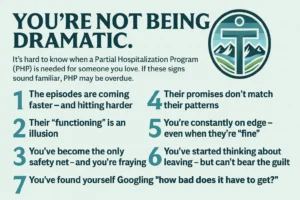
5. You’re Constantly On Edge—Even When They’re “Fine”
You flinch at every phone buzz. You check their location like it’s your job. You keep your tone soft so you don’t “set them off.” You’re either walking on eggshells—or watching your back.
Even their good days don’t feel safe, because you’re always waiting for the next fall.
That’s not what love is supposed to feel like. And your nervous system knows it.
PHP isn’t a punishment. It’s a container for chaos. It’s where your loved one can get real help—and you can stop living in constant crisis mode.
6. You’ve Started Thinking About Leaving—But Can’t Bear the Guilt
You’ve fantasized about walking away. About silence. Sleep. A life not shaped by someone else’s drinking, drug use, or emotional instability.
But then the guilt hits: What if they fall apart without me? What if they think I abandoned them?
Here’s the truth: getting them into PHP isn’t abandoning them. It’s loving them with boundaries.
And if you do end up leaving down the line, it’s okay to know you gave it your all—including the hard, courageous decision to seek real help.
7. You’ve Found Yourself Googling “How Bad Does It Have to Get?”
You’ve scrolled through Reddit threads. You’ve taken “Is my partner an addict?” quizzes. You’ve read blogs like this at midnight, hoping for some kind of clarity.
If you’re even asking this question, you’re not overreacting. You’re in pain. You’ve been in pain. And you don’t need to wait for a rock-bottom event to justify making a move.
Your intuition has been whispering for a while now. Maybe this blog is the moment you decide to trust it.
What Exactly Is a Partial Hospitalization Program (PHP)?
A Partial Hospitalization Program (PHP) is one of the highest levels of outpatient care available.
It provides:
- Structured treatment five to six days per week
- Daily therapy, group sessions, and medical check-ins
- Non-residential format (they go home in the evening)
- Support for both mental health and substance use disorders
PHP is often recommended when someone is struggling too much for traditional outpatient therapy, but doesn’t need—or can’t commit to—24/7 inpatient care.
It’s ideal for people whose lives are unmanageable, but not yet medically critical.
If that sounds like your partner? You’re not alone. And you don’t have to guess what comes next.
FAQs: Helping a Loved One Into a Partial Hospitalization Program
How do I know if PHP is the right level of care for my partner?
If your partner’s emotional or substance use symptoms are interfering with daily life—but they’re not in immediate medical danger—PHP is often a strong fit. Our team can help assess their needs with no pressure.
Will they have to stop working or parenting to attend PHP?
PHP is intensive and does require daytime hours, usually 5–6 hours per day. However, we can help you understand if temporary leave is possible and how to create coverage or support systems during treatment.
What if they refuse treatment?
You can’t force someone into recovery—but you can stop enabling, set clear boundaries, and stop protecting them from the consequences of their choices. Sometimes, making PHP part of a boundary conversation helps clarify what’s needed.
Can they live at home while in PHP?
Yes. PHP is non-residential. Your partner returns home after treatment each day, which is why it’s crucial to create a safe, sober environment for evenings and weekends—or consider a sober living option as an add-on.
Is there a Partial Hospitalization Program near us?
Yes. Titan offers services throughout the Las Vegas area, including Spring Valley and North Las Vegas. We can help you find the closest and most convenient location.
You don’t have to carry this alone anymore.
Call (888) 976-8457 to learn more about our Partial Hospitalization Program services in Las Vegas, Nevada.
You’ve loved them through the pain. Let us help you love them toward healing.