

It’s okay to pause—but it’s also okay to return.
If you stepped away from an Intensive Outpatient Program (IOP), whether after a few days or a few months, you might be wondering if the door is still open. Maybe you ghosted. Maybe life got heavy. Maybe you just didn’t feel ready yet. Whatever the reason—this isn’t the end of your story. At Titan Behavioral Health’s Intensive Outpatient Program in Las Vegas, we believe returning is brave, not broken.
Let’s talk about how to return to IOP without shame, without apology, and without the weight of feeling “too far gone.”
1. Start with a Breath, Not a Backstory
You don’t need a perfect reason to come back. You don’t need to have the right words or a polished timeline of what went wrong. The truth is, most people who work in treatment know that stepping away happens. Life outside treatment doesn’t pause—it pulls, tugs, unravels. Sometimes it’s a mental health dip. Sometimes it’s family stuff. Sometimes it’s just burnout.
Whatever the case, you’re not the first person to stop showing up, and you won’t be the last to find your way back.
When you’re ready to reconnect, start small. A phone call. A message. Even just browsing the Intensive Outpatient Program page again is a step.
2. You’re Not “Behind”—You’re Still in Progress
It’s tempting to believe that if you leave treatment and come back later, everyone will have “moved ahead” and you’ll be back at zero. But here’s the truth: progress doesn’t vanish just because it paused.
The skills, insights, and support you gained before are still with you—even if they’ve been quiet for a while. Healing doesn’t follow a semester schedule. It’s nonlinear, deeply personal, and often cyclical. Coming back isn’t starting over. It’s picking up where you left off, this time with more perspective and (maybe) more humility.
At Titan Recovery Centers, we welcome returning clients with compassion, not comparison. Whether it’s been a few days, a few months, or longer, we meet you where you are.
3. Ask Without Committing (Yet)
You don’t have to be 100% ready to walk back through the door to reach out. If the idea of rejoining your Intensive Outpatient Program feels overwhelming, start with curiosity—not commitment.
Ask questions like:
- What would it look like if I came back?
- Is it okay that I left without saying anything?
- Do I need to restart the whole program?
The answer to that last one is often no. We’re used to people leaving and returning. Some need a few weeks off. Some leave mid-way and return months later. What matters most isn’t explaining your absence—it’s letting yourself consider returning.
In areas like Henderson or Spring Valley, we’re especially committed to helping clients who’ve paused care re-engage without shame or pressure.
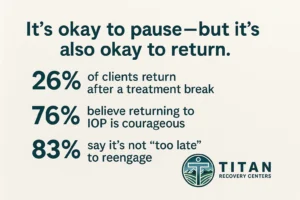
4. Let Go of “Too Late” Thinking
There’s a quiet voice in many people’s heads after they leave treatment that says: You blew it. They probably don’t want you back. You missed your window.
That voice is fear, not fact.
The reality is: healing has no expiration date. There’s no such thing as “too late” to try again. Most of us in this field have watched people leave and return two, three, even four times before something clicked. And every time they came back? It mattered. It added something.
So if you’re holding back because of shame or lateness, try this reframe: I’m not late. I’m here now. That’s enough.
5. Use What You Took With You
Even if your time in IOP was short or scattered, chances are something stuck with you. A coping skill. A phrase. A moment of clarity. A person who made you feel seen. That’s not nothing. That’s evidence that the work you did still echoes.
When you return, you’re not walking in empty-handed. You’re returning with data—about what helped, what didn’t, and what needs to feel different this time. That makes you more prepared, not less.
Maybe last time, you weren’t ready to talk. Or group felt too hard. Or you felt like an outsider. Coming back gives you a chance to try again with different eyes, and maybe with more honest needs.
6. You’re Allowed to Rebuild Trust Slowly
One thing that might feel sticky: the idea that if you “ghosted,” people in the program won’t trust you anymore. You might feel like you let the team down—or like you walked away from people who cared.
Those feelings are valid. But you don’t have to fix it all at once.
You’re allowed to come back with your head low, not because you should be ashamed—but because you’re human and it’s okay to feel awkward. The truth is, most of us don’t expect perfect attendance. We expect real-life mess. What matters is that you’re returning—not that you’re perfectly ready to explain yourself.
7. Reentry Isn’t Weakness—It’s Strength
Walking through the door a second (or third) time takes more courage than the first. The first time, you didn’t know what to expect. This time, you do—and you still showed up. That’s not weakness. That’s resilience.
Choosing to return means choosing yourself, again. And that’s a beautiful, radical thing.
At Titan Recovery Centers, we honor reentry. We’ve built our IOP program in Las Vegas to be flexible, human-centered, and open to your whole story—including the chapters you thought you couldn’t return from.
8. You’re Not Alone—And You’re Definitely Not the Only One
If you’re feeling like the only person who ever left treatment early, we’ll say it plainly: you are one of many. People step away for all sorts of reasons—family issues, mental health struggles, insurance barriers, emotional overwhelm, or just plain burnout.
We’ve seen people walk out mid-session and come back months later. We’ve had clients return after ghosting for a year. And guess what? They still got better. They still found support. They still rebuilt something real.
Your detour is just that—a detour. Not a dead end.
FAQ: Rejoining IOP After Dropping Out
Can I come back even if I left without notice?
Yes. You don’t need to explain or justify your absence. The door is still open.
Will I have to restart the whole program?
Not necessarily. Your reentry plan can be adjusted based on where you left off and what you need now. We tailor it with you.
What if I’m embarrassed to return?
That’s normal—and common. We won’t shame or interrogate you. We’re just glad to see you again.
I left because I didn’t feel ready. What if I still don’t?
That’s okay too. You can reach out just to explore options. No pressure, no lock-in.
Do I need to be sober or stable to come back?
No. IOP is often the place where people get sober and stable—not a reward for already being there. You’re welcome as you are.
Thinking About Rejoining? You’re Welcome Here.
You’re not too late. You’re not a burden. And you haven’t “ruined your chance.” Whether you left last week or last year, Titan Recovery Centers is here to help you return—on your terms, in your time.
Call (888) 976-8457 to learn more about our Intensive Outpatient Program services in Las Vegas, Nevada.
