

You just got a diagnosis.
And now everything feels louder.
The word itself echoes. Anxiety. Depression. Bipolar disorder. PTSD. It’s not just information—it’s identity-shaking. And when medication enters the conversation immediately, it can feel like things are moving too fast.
At Titan Recovery Centers, we don’t rush that moment. We often begin with cbt because when you’re newly diagnosed and scared, you deserve steadiness—not pressure.
The Moment After Diagnosis Is More Emotional Than Clinical
Most people don’t talk about this part.
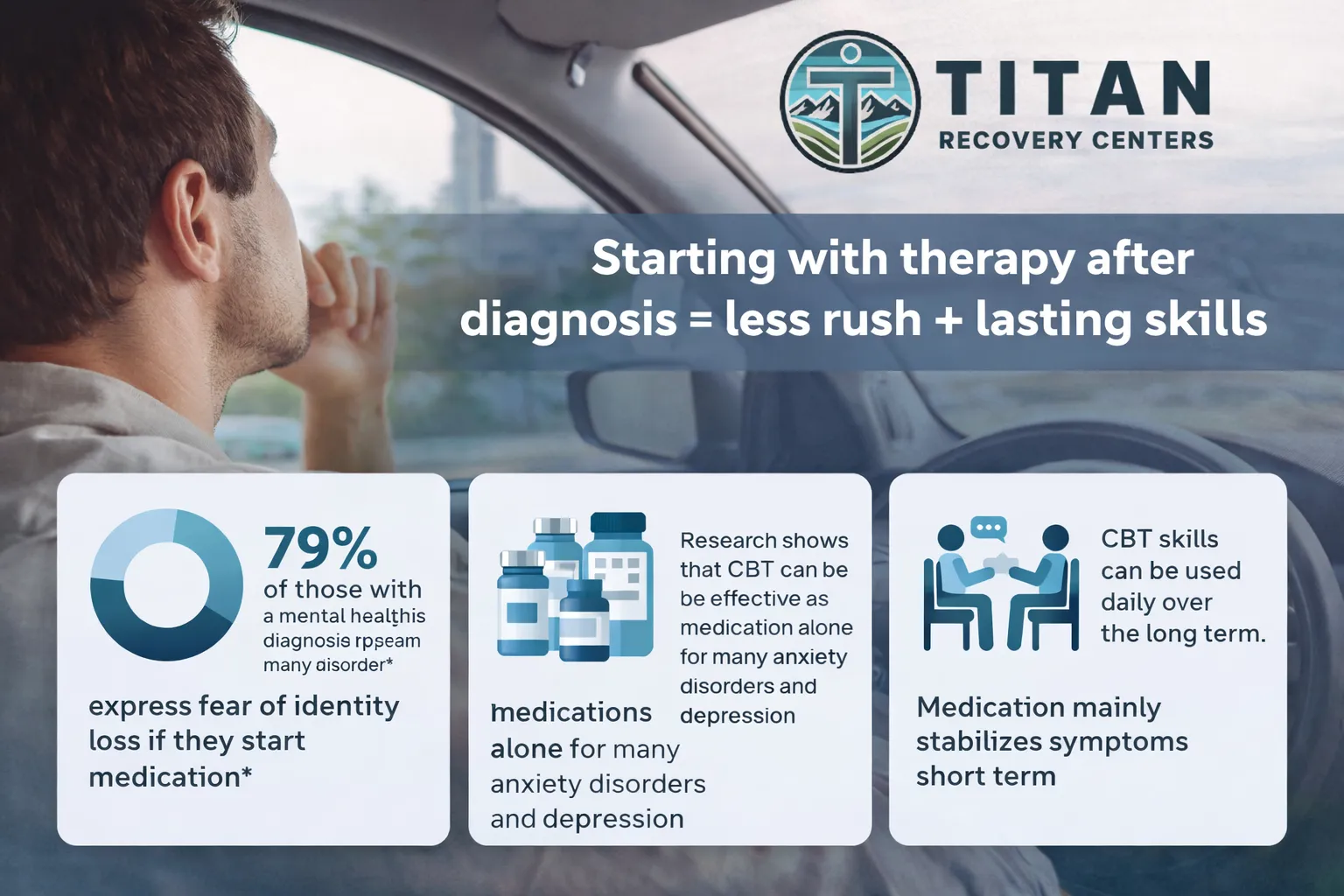
You sit in your car after the appointment. The world looks the same—but it doesn’t feel the same. You replay the doctor’s words. You google. You spiral. You wonder if this means something is fundamentally broken inside you.
Then comes the medication discussion.
For some, that feels hopeful. For others, it feels terrifying.
You might think:
- What if this changes who I am?
- What if I feel numb?
- What if I lose my creativity?
- What if I become dependent?
- What if this diagnosis becomes permanent?
Those questions aren’t resistance. They’re human.
And when someone is scared to take medication, pushing harder rarely builds trust.
Why We Start With CBT When Fear Is Front and Center
Cognitive behavioral therapy (cbt) is often our first step because it builds understanding before intervention.
CBT helps you:
- Identify thought patterns driving distress
- Recognize cognitive distortions
- Interrupt emotional spirals
- Develop coping skills grounded in evidence
Instead of altering brain chemistry immediately, CBT gives you tools to observe and shift your internal dialogue.
For someone newly diagnosed, that matters.
It restores a sense of participation. You’re not being “treated.” You’re learning how your mind works.
That shift—from passive patient to active participant—can be powerful.
You’re Not Afraid of Getting Better. You’re Afraid of Losing Yourself.
This is the part many people don’t say out loud.
Medication fear isn’t always about side effects. It’s about identity.
If you’ve lived with intense emotions, deep thinking, heightened sensitivity, or creative bursts—those traits may feel intertwined with who you are.
You may wonder:
If the medication works… will I still feel like me?
CBT respects that fear.
It doesn’t flatten your emotions.
It doesn’t mute your personality.
It doesn’t sedate your intensity.
Instead, it asks:
Which thoughts are helpful?
Which ones are distortions?
What patterns are protecting you—and which are exhausting you?
It challenges the story without erasing the storyteller.
CBT Builds Skill Before We Add Support
When someone is newly diagnosed, everything can feel urgent.
But urgency doesn’t always equal clarity.
CBT provides a structured, practical foundation. In sessions, you might:
- Track anxious predictions and compare them to reality
- Identify all-or-nothing thinking patterns
- Practice behavioral activation when depression pulls you inward
- Learn grounding techniques for emotional spikes
- Develop structured routines that stabilize mood
These are not abstract exercises. They’re daily-life skills.
Over time, you begin noticing something subtle but powerful:
You can influence your thoughts.
You can interrupt emotional spirals.
You can build stability.
For many clients, symptoms decrease significantly through therapy alone.
For others, CBT clarifies that medication could be a helpful addition—not a forced first move.
Medication Isn’t Rejected—It’s Considered Thoughtfully
Let’s be clear: we are not anti-medication.
There are times when medication is life-changing. There are situations where symptoms are severe enough that combining therapy and medication is the safest, most effective path.
But what we don’t do is treat medication like a reflex.
When someone is newly diagnosed and hesitant, collaboration matters more than speed.
CBT gives space to explore:
- What are your biggest fears about medication?
- What would feeling “better” actually mean to you?
- Are symptoms improving with therapy alone?
- Would additional support enhance your progress?
That process transforms medication from something imposed to something chosen.
And choice changes everything.
The Psychology of Fear Around Medication
Fear of psychiatric medication is rarely irrational. It often stems from:
- Stories from friends or family
- Media portrayals
- Prior negative experiences
- Cultural stigma
- Fear of dependency
- Fear of personality changes
When those fears are dismissed, trust erodes.
When those fears are explored through CBT, something different happens.
We examine the belief itself:
- What evidence supports this fear?
- What evidence challenges it?
- Is the fear predictive or protective?
- What outcome feels most aligned with your values?
CBT doesn’t silence fear. It investigates it.
And investigation reduces panic.
Starting With Therapy Strengthens Long-Term Outcomes
Research consistently shows that cognitive behavioral therapy is highly effective for conditions like anxiety disorders, depression, PTSD, and mood-related challenges.
More importantly, CBT teaches skills that remain long after sessions end.
Medication may stabilize symptoms—but CBT builds internal scaffolding.
It strengthens:
- Emotional regulation
- Cognitive flexibility
- Stress tolerance
- Behavioral activation
- Self-awareness
Think of it this way:
Medication can turn down the volume.
CBT teaches you how to use the controls.
Both have value. But learning the controls first often feels empowering—especially when you’re newly diagnosed and unsure.
What CBT Actually Feels Like
There’s a misconception that therapy is endless talking without direction.
CBT is structured. Collaborative. Measurable.
You might leave sessions with:
- A thought record worksheet
- A specific behavioral experiment
- A grounding strategy to practice
- A reframing exercise
- A clear goal for the week
Progress is trackable. Patterns become visible. Emotional spikes become understandable.
And understanding reduces fear.
We’ve seen this approach resonate deeply with individuals seeking mental health support in Henderson, Nevada. Many arrive feeling unsure about medication but open to learning skills first. That willingness becomes a foundation.
Similarly, individuals in North Las Vegas, Nevada often express relief when they realize therapy can be a starting point—not a last resort after medication.
The pattern is consistent: when people feel heard, they engage more fully.
You Don’t Have to Decide Everything at Once
A diagnosis can make you feel like you’re standing at a crossroads with flashing signs pointing in every direction.
Therapy. Medication. Lifestyle changes. Support groups. Psychiatric consults.
It’s overwhelming.
CBT slows the process down.
It says:
Let’s understand your mind first.
Let’s build stability.
Let’s evaluate as we go.
You are allowed to:
- Ask questions
- Take time
- Express doubt
- Change your mind
- Try therapy first
Mental health care should feel collaborative—not rushed.
Frequently Asked Questions About CBT and Medication
Is CBT effective without medication?
For many individuals, yes. CBT is considered a first-line treatment for anxiety disorders, mild to moderate depression, and trauma-related conditions. Severity and individual history matter, but many clients experience meaningful improvement through therapy alone.
How long should I try CBT before considering medication?
There isn’t a universal timeline. Some people notice improvement within weeks. Others need several months to build momentum. The key is ongoing assessment. We evaluate progress collaboratively rather than imposing deadlines.
What if my symptoms are severe?
If symptoms include extreme mood instability, suicidal ideation, or significant functional impairment, medication may be recommended sooner. Even then, CBT remains a critical part of care.
Can CBT and medication work together?
Absolutely. Many clients benefit from combining both. CBT strengthens coping and cognitive skills while medication stabilizes neurochemical imbalances. The two approaches often complement each other.
Will CBT change my personality?
No. CBT targets unhelpful thought patterns and behaviors—not personality traits. The goal is clarity and flexibility, not emotional flattening.
What if I start CBT and still feel unsure?
That’s part of the process. Therapy is a space to explore uncertainty. You don’t need absolute clarity before you begin.
A Final Thought for the Newly Diagnosed
If you’re sitting with a new diagnosis and a prescription you’re unsure about, your hesitation doesn’t mean you’re resistant.
It means you care about your identity.
It means you want to understand your mind.
It means you want to move thoughtfully.
That’s not weakness. That’s wisdom.
CBT offers a place to start without forcing you to leap.
At Titan Recovery Centers, we believe healing works best when it feels collaborative, informed, and respectful of who you are—not just what you’ve been diagnosed with.
You don’t have to surrender yourself to get better.
Call (888) 976-8457 to learn more about our Cognitive Behavioral Therapy in Las Vegas, Nevada.
